Embedded in our collective memories are certain scenes of our country’s past. Benjamin Franklin capturing electricity with a kite and a key. Patriots disguised as Native Americans tossing tea overboard at the Boston Tea Party. George Washington crossing the Delaware with his troops in the dead of winter. Sadly, most of us never get past the iconic pictures or catchy phrases which tickle our memories. Instead we should choose to delve into the fascinating circumstances, facts, and people which made those events truly worth remembering and helped make us who we are today.
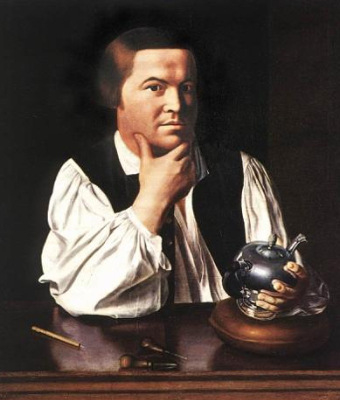
Take for instance Paul Revere’s “midnight ride.” We learned as kids in school that he rode horseback all night to warn the people of Massachusetts that British were marching toward Lexington and Concord and that the clash between the British troops and militia sparked the Revolutionary War. But there is more. So much more.
Let’s start with how Revere was chosen for this secret mission and how much mileage he racked up. First, this was not his “first rodeo” as we say in our time. In the last month of 1773 he had ridden from Boston to New York City to Philadelphia to deliver an account of the Boston Tea Party, an event in which he had participated. On September 11, 1774, he rode hard to Philadelphia to deliver the Suffolk Resolves to the First Continental Congress. Written by Revere’s close friend and fellow patriot Joseph Warren, the Resolves protested British impositions and instructed towns in Massachusetts to stop paying taxes, boycott British goods, and begin organizing military defenses.
Congress endorsed the Resolves, ordered colonial newspapers to print them, and gave letters for Revere to carry to John and Sam Adams when he arrived back in Boston. In late October, Revere was on the road to Philadelphia again; then soon to Portsmouth, New Hampshire, where rebels were seizing gunpowder and other military stores from Fort William and Mary. There were more rides to come, and others already taken but not recorded here. The distance between Boston and Philadelphia alone was more than three hundred miles; between Boston and New York more than two hundred fifteen miles.
Revere’s “mileage” was one thing, but it was another on borrowed or rented horses, on roads often barely passible, and in hot, humid summers or freezing winters. Revere was a patriot, one of the Sons of Liberty, but he also had a business to run and a growing family to support (his first wife died leaving him with six children and his second wife was pregnant with the first of her eight children). For most of his rides, he received a modest compensation but was always aware that his actions might come under British scrutiny. After all, British Major John Pitcairn was billeted next door to Revere’s own home. It would be Pitcairn who would lead the British troops to Lexington and Concord. Moreover, Revere would be caught by several Redcoats on his way to Lexington. They foolishly released him but kept his horse. He finished his famous “midnight ride, ” but on foot.
Paul Revere was a respected engraver and silversmith. On the side, he practiced dentistry. In 1770 he had placed an advertisement in the Boston Gazette boasting that he could replace lost front teeth with artificial ones “as well as any Surgeon-Dentist who ever came from London.” They would “not only be an ornament, but of real use in speaking and eating,”
One of Revere’s patients was Joseph Warren, a well-respected physician and prominent patriot managing a network of spies, organizing troops, and rallying the people, known for cancelling his patient’ debts, opposition to slavery, stirring oratory, and caring for the wounded after the Boston Massacre. It was Warren who activated his spy network on April 18, 1775, and dispatched Revere and William Dawes to Lexington and Concord to warn them of the British advance.
Two months later, patriot soldiers began building a temporary fortification at the top of Breed’s Hill, located next to Bunker Hill in Charleston. Warren had been commissioned a Major General in the patriot militia, but when two thousand British troops advanced on the rebels on June 17, he chose to join the battle with the common soldiers. Weeks earlier, Warren had commented to a friend, the British “say we won’t fight. By heavens, I hope I shall die up to my knees in blood.” Armed with pistols, sword, a musket, and his Bible, Warren plunged into ferocious fighting, inspiring courage in others until felled by a shot under his left eye, killing him immediately.
Fully aware of the identity of the bloodied martyr, British soldiers stripped Warren’s body of clothes and personal items, including his Bible, and mutilated his body by repeated bayoneting, “committing every act of violence upon his body,” before unceremoniously tossing it into a mass grave. Months passed before Warren’s brothers were able to retrieve his body. But first, it had to be identified. Mutilated, stripped of personal clothing and possessions, and in a deteriorated condition, the body was not easily identifiable, until Warren’s close friend and compatriot Paul Revere settled the question.
Sometime before, Revere had replaced two of Warren’s teeth with artificial ones, using a silver wire – all uniquely identified by Revere in what was most likely the first ‘forensic dental identification” in United States history.