
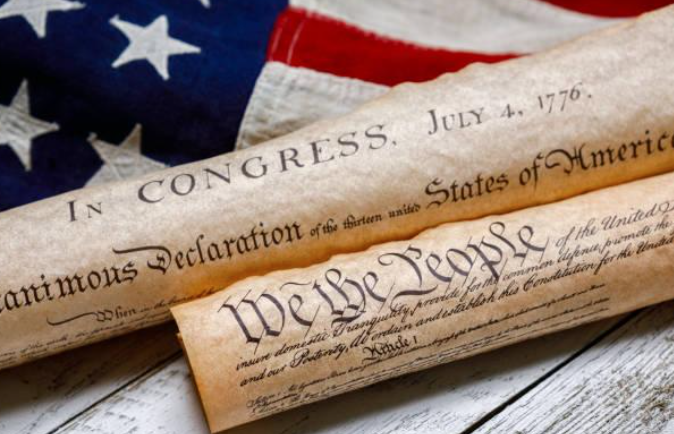
USA250-OC has taken as its basic philosophy a simple but profound observation – that America is the perfect idea: the United States of America is a work in progress. It pits the ideal against the real; principles against human action; the perfect against the imperfect.
The story of the United States is, at its core, a story about the chasm between an idea and its imperfect realization. “America” is more than a place on the map. It is a philosophical proposition, a set of principles aspiring to universal human dignity. The United States, by contrast, is the living, breathing nation attempting – sometimes haltingly, sometimes boldly – to bring those principles to reality. Understanding the tension between these two is essential to understanding the nation itself.
The idea of America is remarkably ambitious, built on the belief that all men are created equal; that they possess inherent rights; that liberty is not granted to them by government, but that government is meant to secure and protect those rights; and that government is to serve the people, not to command them. These ideals are embedded in the Declaration of Independence and have echoed across generations and around the world. They envision a society where equality is not an aspiration but reality; where opportunity is shared, not selective; and where freedom is guaranteed and protected, not conditional or discriminatory.
The United States of America – the nation tasked with embodying these ideas – has always been a work in progress. From its inception, it has wrestled with contradictions: slavery in a land proclaiming liberty; exclusion of some in a republic claiming equality; and injustice in a government built on the rule of law. These contradictions did not completely disappear over time. At times, they evolved, resurfacing in new forms and requiring new responses. Closing the gap between the idea and the real, between principle and practice, has defined every era of American life.
Referring to the United States as “a work in progress’ is not an insult or indictment. It is an acknowledgement of the nature of democracy and of human nature itself. Writing in “Federalist No. 51,” designed to explain and urge ratification of the Constitution, James Madison argued for a form of government that would recognize and address the flaws and ambitions of individual people.
“If men were angels,” he wrote, “no government would be necessary. If angels were to govern men, neither external nor internal controls on government would be necessary. In framing a government which is to be administered by men over men, the great difficulty lies in this: you must first enable the government to control the governed, and the next place, oblige it to control itself,”
Madison argued that people are imperfect, driven by a mix of virtue, self-interest, ambition, and emotion. In a perfect world populated by flawless people, no one would harm or exploit others. But in the real world, people sometimes act unjustly, and conflicts arise. Government exists to manage these conflicts, uphold rights, and protect the weak from the strong.
However, as Madison noted, government is composed of men. They, too, must be restrained. That is why we need a government strong enough to maintain order and protect rights, but limited to prevent tyranny. This is why our Constitution incorporates federalism, separation of powers, checks and balances, and limits on government power.
Madison’s observation provides the framework for understanding why governments must be both empowered and restrained, a tension that continues to shape our modern political debates. It also informs the tension between the idea and the reality of America.
The power of the United States has not come from perfection. It has come from aspiration, from the belief that we can be better tomorrow than we were yesterday, from the determination to narrow the gap between who we are and who we claim to be. Progress is not guaranteed. It is earned. Abolitionists fought to end slavery. Women demanded the vote. Civil rights leaders marched for justice. It moves forward by people who believe the idea of America is worth the effort to make it real, from the willingness to bridge the gap between who we are and who we claim to be.
In the end, it is up to us – you and me – to bridge that gap, to listen to and learn from each other, to remain committed to the aspirations of our founding that changed the world, to participate as informed citizens in the work of a democratic republic.
America is the perfect idea. The United States is a work in progress.
The story of America is written in the space between them.