
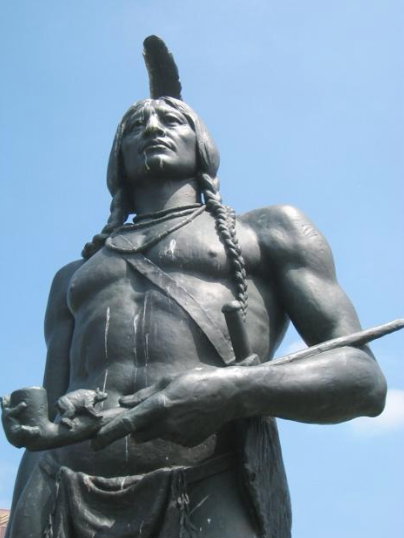
Historians, scholars and pundits may disagree over whether the hand of Providence was evident in the origins of our nation’s history. But none can deny the improbabilities related to pivotal events throughout our founding. One such improbability took place in 1621, months after 102 Pilgrims seeking religious freedom landed on the coast of Massachusetts, 250 miles off course.
Half of the settlers had died of cold, starvation or disease, leaving them especially vulnerable to potentially hostile Native American tribes. Their bodies lay in unmarked graves near the rude huts hastily constructed to shield the men, women, and children who had traversed the Atlantic ocean on The Mayflower. Now, on March 16, 1621, the surviving Pilgrims set out to improve their meager defenses. Their fears turned to alarm when they saw a stranger approach the hilltop on which their huts were arranged. Several men approached him with caution, dumbfounded when he greeted them with a robust, “Welcome, Englishmen.”
This was not the first Native American they had seen. The smoke of their fires in the distance had been observed. Occasionally, one could be seen watching them from behind trees. Captain Miles Standish tried to make contact, but the effort failed. Fear of being overcome in a rapid assault by a bank of armed Indians had consumed their thoughts throughout the winter. But here was one of them, bellowing a second time, “Welcome, Englishmen!”
His name was Samoset, a member of the Abenaki tribe. After asking for a beer in his broken English, he explained he had learned some English while befriending a cod fisherman. For an unknown reason, he had been picked up by a Captain Thomas Dermer on his 1619 expedition and then dropped off near Cape Cod where he now lived. He also explained that the site of the Pilgrim’s current settlement was known as “Patuxet” or “Little Bay” and its former inhabitants had died of a plague. Moreover, he told them that several allied tribes were organized under a leader named Massasoit and among them was another, more fluent English-speaking Indian named Tisquantum or “Squanto.”
After spending the night with the Pilgrims and receiving gifts, Samoset returned to his village, returning several days later with Tisquantum who arranged a meeting with Chief Massasoit. Massasoit and the Pilgrim leaders treated each other with respect, resulting in a peace treaty crucial to the survival of the nascent colony, including a provision we would call a “mutual defense” pact. The Plymouth Colony-Wampanoag Treaty would last for fifty years.
After Massasoit left, Squanto and Samoset stayed behind where, according to William Bradford, governor of Plymouth Colony and author of Of Plymouth Plantation, Squanto became a trusted friend, advisor, and teacher to Bradford and his small band of pilgrims.
Squanto had been the sole survivor of the thriving Patuxet tribe that had originally inhabited the land settled by the Pilgrims a year earlier. He and twenty other captives had been kidnapped by an English sea captain and taken to Malaga on the Mediterranean coast of Spain to be sold as slaves, but a group of Spanish monks purchased them, nourished their wounds, and instructed them in Christianity. It is uncertain how Squanto made his way to England, where he lived with a merchant’s family, learned English, and eventually managed to fine his way back home. But when he arrived, he learned his entire tribe had been wiped out by a devastating plague. Soon Squanto moved in with the Pokanokets, neighbors of his decimated tribe, whose leader was Chief Massasoit.
The peace treaty settled, Squanto chose to stay with the Pilgrims on the site of his ancestors’ tribal land where he became an essential part of the community. He taught them to fish in strange new waters, plant corn, trap beaver, adapt and thrive in a hostile environment, and navigate the wilderness. Plymouth was not England and the settlers had much to learn.
Relations between the Wampanoags and the Plymouth colony as well as among the Native America tribes and the intrigues surrounding Massasoit’s leadership are more complicated than the popular history of Squanto records. But the indispensable contributions Squanto made to the Pilgrims were displayed when they sent an armed expedition to free him after being captured by a group of hostile Indians.
In November 1622, Squanto fell ill and died of a fever on the last day of the month. He is said to be buried in Chatham, Massachusetts. Had Squanto not been kidnapped, learned to speak English and returned to his homeland, he would have succumbed to the scourge that destroyed his tribe instead of living to assure the survival of Plymouth Colony. This was the man whom William Bradford called “a special instrument sent of God for their good beyond their expectation.”