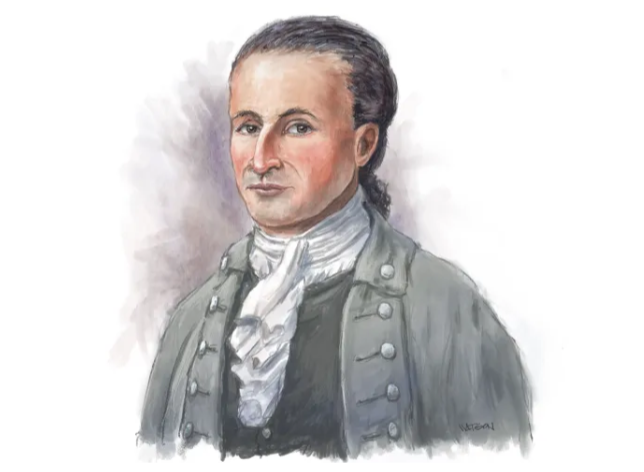
January is often viewed as a month of beginnings, of newness, of resolving to make something better. January 11, 1775, was such a date in the history of the thirteen British colonies which became the United State of America when Francis Salvador took his seat in the First Provincial Congress in South Carolina, becoming the first Jew elected to public office in colonial America.
Since the founding of the colonies in North America, the Salvador family had been instrumental in helping Jews to establish Jewish communities in the New World, including those in Georgia and South Carolina. Descended from a line of Sephardic Jews who had settled in London, Salvador’s great-grandfather, Joseph Salvador, had been the first Jewish director of the East India Company and over time the family retained ties and investments in the Company. Unfortunately, Salvador’s family fortunes were all but ruined by financial losses connected with an earthquake in Lisbon, Portugal, leaving little but their land in South Carolina.
Believing his family’s future was in America, Francis purchased 7,000 acres in South Carolina from his father-in-law and set out for the new world in 1773, leaving his wife and four children behind, intending to send for them later. The land was located in the western frontier as part of District Ninety-Six and would soon become a strategic point in the Revolutionary War.
Establishing an indigo plantation, he was soon drawn into politics and the burgeoning drive toward independence. Committees of Correspondence had spread through the colonies, including South Carolina, where a Provincial Congress was elected to serve as a temporary government. Although South Carolina, like other colonies, had required that voters and elected officials be Christian, no objections were made to Salvador’s being Jewish.
The First Provincial Congress met in Charleston on January 11, 1775, where it drafted a new Constitution, a bill of rights, and a letter to the royal governor listing their grievances against King Georg III. Six days later it resolved that “all inhabitants of this colony…be diligently attentive in learning the use of arms; that their officers be requested to train and exercise them at least once a fortnight.” Within weeks, companies of militia were assembled throughout South Carolina. On May 10, representatives of South Carolina met with those of other colonies in Philadelphia at the Continental Congress.
Francis was an active member of the Provincial Congress, participating in addressing its most pressing concerns as well as leading a commission to convince South Carolinians in the north and west sections of the colony to support the American cause. He was elected to the Second Provincial Congress, chaired the Ways and Means Committee, served on a committee authorizing pay to members of the militia, and advocated strongly that the Provincial Congress should instruct its delegates to the Continental Congress to vote for independence.
Throughout the French and Indian War, both the French and the English had enlisted allies from various Native American tribes. Now, as the war for independence intensified, the British and the rebellious colonists contrived to enlist tribes to their cause. Early in 1776, Cherokees began raiding settlements on the frontier, prodded by the British who wanted to create a diversion from their operations on the coast. The attack began on July 1. On horseback, Salvador rode twenty-eight miles to the plantation of Major Andrew Williamson to warn militia units, thus earning him the nickname “Southern Paul Revere.”
Less than a month later, on August 1, during a campaign led by Williamson, the militia suffered an ambush by Loyalists and Cherokees at the Keowee River. Salvador was wounded, fell into the busses, discovered, and scalped, becoming the first Jew known to have died for American independence. He was twenty-nine years old.
In 1950, the City of Charleston erected a memorial to Francis Salvador, noting his service and summarizing his life: “Born an aristocrat, he became a democrat; An Englishman, he cast his lot with the Americans; True to his ancient faith, he gave his life; For new hopes of human liberty and understanding.”
At the time of the Revolution, the Jewish population in the colonies approximated 2000 persons. They had come to the new world for the same reasons others had come – freedom of religion, economic opportunity, a new start. In most countries throughout the world, they could not own land, vote or be elected to public office; they were excluded from many occupations; they had been expelled altogether; they were “always aliens.” But in America, this would change, and Francis Salvador was part of that change.
America offered new hopes and freedom to Jews. Their story is America’s story, just as are the stories of Africans, Irish, Poles, Italians, Chinese, Koreans, Hispanics, Albanians, English and more. Understanding our stories in light of the principles laid out in the Declaration of Independence – the unalienable rights to life, liberty and the pursuit of happiness – should be a goal of all Americans.