
 On April 28, 2026, Britain’s King Charles III visited the United States to join in the 250 th anniversary of the Declaration of Independence which separated 13 North American colonies from the British Empire. By all accounts his visit was a resounding success as he addressed a joint session of Congress, laid a wreath at the Tomb of the Unknown Soldier in Arlington National Cemetery, and shared solemn moments at the National September 11 Memorial in New York.
On display was the King’s dry, quick-witted, and unexpectedly playful humor, frequently delivered with a straight face but with a royal twinkle in his eyes. Take for instance, his quip about the “re-adjustments to the East Wing” – a reference to the controversial addition of a ballroom to the White House. Turning his gaze to President Donald Trump, King Charles said, “I am sorry to say, we British of course made our own small attempt at real estate re-development of the White
House in 1814,” a line drawing big laughs from the President and those in attendance.
So, what happened in 1814? How many Americans (or Brits for that matter) remember the major conflict between our two countries that could have toppled the United States before its 40 th anniversary? This is “the story behind the story.”
It was early in the morning of August 24, 1814. Dolly Madison, wife of James Madison, the fourth President of the United States, clambered to the roof of the Executive Mansion in the nation’s capital. It would not be called the White House for another century. Using a spyglass, Dolly searched as far as she could see, hoping to see her beloved “Jemmy,” as she called him. Two days earlier he had left on horseback to join the militia advancing to defend the city from British forces.
The President had left instructions for his wife where to meet should she be forced to evacuate the city before his return.
The United States and Great Britain had been at war for more than two years. Humiliated by its loss to a ragtag colonial army bolstered by Franch troops at the end of the Revolutionary War, the British had escalated tensions with the United States during the Napoleonic Wars by blocking commerce with France and “impressing” American sailors – seizing them from U.S. ships and forcing them into service in the Royal Navy. British incitement of Native American tribes opposing expansion in the western territories added to the reasons why Congress had finally declared war on June 18, 1812.
Secretary of State James Monroe and a small group of soldiers had been scouting the Maryland countryside since the 22 nd , sending messages back to Washington of the overwhelming fleet of British warships sailing into Chesapeake Bay. Their target – Baltimore. But the President had received additional but unconfirmed intelligence that Washington was also in jeopardy. As word spread rapidly throughout the city, residents began evacuating, commandeering whatever means of transport they could find – wagons, carts, carriages, anything that could carry even a small load of personal and business possessions.
On Capitol Hill, clerks began gathering important papers. At the State Department, a senior clerk named Stephen Pleasanton ignored the Secretary of War’s denial that the capital was endangered and fashioned make-shift bags from course linen cloth, into which the original and signed copies of the Declaration of Independence, the Constitution, the Articles of Confederation, and other precious documents were stuffed. He then transported them by wagon to an old, abandoned mill across the Potomac River to Virginia, then to an empty house in Leesburg where they would remain for several weeks until the emergency passed.
Finally, as the situation became more perilous and there was no news of the whereabouts of the President, Dolly was persuaded by close friends and her servants to abandon the Executive Mansion and flee the city, but not before she collected important government documents as well as the still-unknown-to-the public her husband’s invaluable notes of the Constitutional Convention.
Among the last items to be removed was the already famous portrait of George Washington.
Hours later, British troops entered the city, setting the Mansion ablaze after ransacking its contents. Next came the burning of both chambers of the Capitol building, the Library of Congress and other government buildings. The carnage and destruction, it was said, was in retaliation for the torching and looting of Toronto, Canada, a British stronghold, by American soldiers the year before.
The British would have their revenge.
The red glow of the conflagration could be seen for miles, including from the tavern where Dolly and the president had planned to meet. But, as if by a miracle, a tremendous storm arose, with such violence that roofs were blown off of houses in the capitol city; but it served to quench the fire.
On August 28, the President and Dolly returned to the city and an utterly destroyed home, to be rebuilt but never to be occupied by James and Dolly Madison.
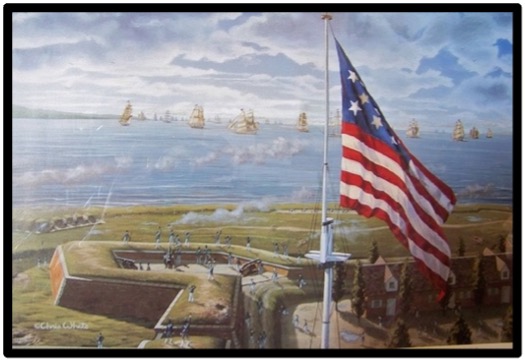
Less than a month later, the British would launch an assault on Fort McHenry near
Baltimore, but the American defenses would hold and a young American lawyer named Francis Scott Key would watch “the rockets red glare” and “the bombs bursting in air,” relieved to see in the dawn’s early light that the American “flag was still there” – tattered and torn but still flying over Fort McHenry.
And that is “the story behind the story.”