He had participated in the surrender of the British at the Battle of Saratoga on October 17, 1777, which tilted the scale for the Americans in their fight for independence and secured France’s support for their cause. He witnessed the first time in history that a British Army surrendered to another country. During the battle, he had received a severe wound in his right leg, leaving him permanently lame, with one leg two inches shorter than the other.
Less than a year later, having recovered from his injury, he was appointed by General George Washington as commander of the Southern Department of the Continental Army to oppose the British forces under the command of Generals Henry Clinton and Charles Cornwallis. In March 1780, he took command of the garrison at Charlestown, South Carolina. Lacking sufficient men and resources, boxed in by a sizable British force, and subject to weeks of bombardment of his defenses, General Benjamin Lincoln participated in his second wartime surrender – this time of his own army.
Key to the British victory was the strategic arrival and positioning of Cornwallis’s troops along the Cooper River, cutting off Lincoln’s men from their only overland escape path and preventing reinforcements or retreat. On May 12, 1780, Lincoln surrendered, resulting in the capture of more than 5,000 American troops, over 300 cannon, 6,000 muskets, and stores of gunpowder. In the meantime, he had managed to assist in the escape of the South Carolina militia and some Continental forces, further agitating the British who had already demanded unconditional surrender.
The loss of the southern army at Charlestown was the worst Continental defeat of the Revolutionary War. Adding insult to injury, the British denied to Lincoln and his troops the honors of war, a traditional set of privileges respecting the valor of a defeated army. These generally included permitting the surrendering force to march out with flags unfurled, drums beating, and bayonets fixed before laying down their arms with dignity and being paroled or exchanged, often to the tune of a military band. Officers were allowed to keep their own sidearms and personal effects.
Sir Henry Clinton specifically refused to afford these honors to Lincoln and the Americans. Instead, Lincoln’s soldiers were not permitted to march out with their flags displayed or their drums beating. Instead, they were required to surrender as captives. British troops reportedly mocked the Americans as they deposited their arms. The captured Continental standards were seized, and the American soldiers were denied the ceremonial recognition normally afforded a gallant defense.
Months later, Lincoln was exchanged for two British generals and by the summer of 1781 was commanding one of three divisions of the Continental Army as it marched south with the added strength of the French Expeditionary Force which had arrived in Newport, Rhode Island, in mid-July under the leadership of General Jean‑Baptiste Donatien de Vimeur, Comte de Rochambeau. Gathering additional forces as they headed south, the allied forces focused on their strategic goal – the British encampment at Yorktown, Virginia.
The siege of Yorktown began on September 28. Like Lincoln at Charlestown, Cornwallis found himself and his army boxed in with no hope for escape – the British fleet now controlling the York River and access to the sea. By mid-October, it was all over. Cornwallis signed the order to surrender on October 17, exactly four years after the Americans’ historic victory at Saratoga.
As customary, Cornwallis requested the honors of war. However, Washington, remembering to the treatment given to Lincoln at Charlestown, responded, saying Cornwallis’s surrendering army would receive “the same honors…as were granted to the garrison of Charlestown.”
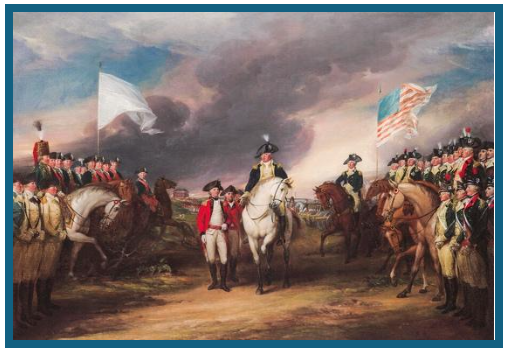
On October 19, the formal, ceremonial act of the surrender of Yorktown marked the unofficial end of major combat in the Revolutionary War. Citing illness, General Cornwallis did not attend. In his place, he sent Brigadier General Charles O’Hara. The allied American and French troops formed two lines, extending more than a mile. The French were in full military uniform, the Americans in a variety of attire, including buckskin and homespun. The British soldiers marched between the two lines, their flags cased, refusing to look at the ragtag mix of Americans, focusing their gaze downward or toward the French. According to legend, the famous French general, the Marquis de Lafayette, outraged at the disrespect, ordered the fife and drum corps to play “Yankee Doodle Dandy,” jolting the British soldiers to face the Patriot victors. In a sullen reproach, many threw their weapons down violently, rather than surrender them in an orderly, dignified manner.
O’Hara approached Rochambeau to ceremoniously surrender not his own, but Cornwallis’s sword. Respectfully deferring to Washington, Rochambeau directed O’Hara to Washington, who, in turn, gestured to Benjamin Lincoln. Lincoln would have the honor of receiving the sword of surrender.
Eight years later, Americans would participate in the first election for President under the recently ratified Constitution. Sixty-nine electors would cast two ballots, each for a different person. The two with the most votes would become President and Vice President. Sixty-nine Electors voted. George Washington received sixty-nine votes to become our first President. John Adams received 34 to become Vice President. Twelve others received at least one vote. Benjamin Lincoln was one of them.
USA250-OC#58