
The American Revolutionary War was a major turning point in American history. During this conflict, thirteen American colonies fought to gain independence from Great Britain – and they won. Although the war is generally described as a struggle between the colonists and the British, it had world-wide repercussions, impacting the politics and economies as far distant as India, Africa, the Caribbean, Ireland, Canada – far beyond the familiar borders associated with the principles and grievances enumerated in the Declaration of Independence.
Too often neglected in our histories of those years are the tribal nations who were also involved, deciding whether to remain neutral or choosing to align with one side or the other to safeguard their peoples and protect their lands, sovereignty, self-government, and survival.
The Oneida nation, for example, supported the Patriots, along with many Tuscarora. Its leader, Atayataghlonghta, “Colonel Louis Joseph Cook,” became the highest-ranking officer of Native American or African descent in the Revolution. The son of a black man and Abenaki woman, he had been adopted by the Mohawk after his family was taken captive in a joint French-Kahnawake raid in 1745. Raised near a Jesuit mission, he learned to read and write, converted to Roman Catholicism, and received the name Louis Joseph Cook at his baptism.
During the French and Indian War, he joined the Mohawks in their campaigns against the British. In 1775, he took up arms with the Patriots in their failed invasion of Quebec, fought in the battles of Oriskany and Saratoga, joined the Oneida delegation to Valley Forge, and received a commission of Lieutenant Colonel from the Continental Congress. Many years later, in 1814, more than seventy years of age, he still fought as an American during the War of 1812 at the ill-fated Battle of Lundy’s Lane, where he was injured and eventually died of his wounds. He was buried with full military honors.
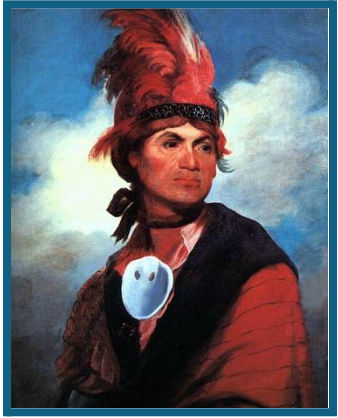
Joseph Brant, also known by his native Mohawk name Thayendanegea, chose to ally with the British, playing a crucial role in influencing the Iroquois Confederation to side with the British. His parents were Peter and Margaret Tehonwaghkwangearahkwa. When Peter died, Margaret remarried and took the name of her new husband, which translated into Brant. Joseph received an excellent education and as a teen took part in the French and Indian War on the side of the British, even fighting with the Iroquois against Chief Pontiac during Pontiac’s War.
Well educated, he was selected in 1774 by Guy Johnson, superintendent of Indian Affairs, as Johnson’s secretary and remained loyal to the British, was commissioned as a colonel, and accompanied Johnson to London to secure additional support from the government. Brant met King George III and the colonial secretary, George Germain, to advocate for concessions for the Iroquois in return for their loyalty, noting their sacrificial efforts on behalf of the British during the French and Indian War. Brant was a fearless warrior, skillful negotiator, and effective advocate for education and Christianity among his people. His reputation, built upon a solid life of experienced leadership, places him as one of the great leaders of Native Americans of his time.
Native Americans often used their knowledge of the land, forests, rivers and travel routes to the advantage of their allies, whether Patriot or British. They participated in raids and battles and served as guides, translators, emissaries, and scouts. Just as Americans were divided between Patriots and Loyalists, the First Americans were also divided, tribe against tribe, yet all the while seeking to protect their lands, their independence, and their culture.
At the same time, in 1776, Spanish colonists were extending their boundaries up and down the shores of the Pacific Ocean, establishing missions and presidios and working to transform the lives of Native Americans to conform to Spanish agriculture and village life. Among the most important of the Spanish missionaries in America was Father Junipero Serra, appointed Father President of the Alta California Mission in 1769. Born in Mallorca, Spain, Father Serra established nine missions, including Mission San Juan Capistrano, posing changes and challenges for the indigenous Acjachemen whose culture, language, religion, work, clothing, and food were forever changed. Lack of natural immunity to European diseases, poor sanitation, and changing lifestyles resulted in a seventy-four percent decline in the Acjachemen population by 1830.
The name of Father Junipero Serra is among the most recognized in California’s early history. His statue is one of two representing California in Statuary Hall in the nation’s Capital, but few can recognize the name of the Acjachemen people or other tribes which inhabited early southern California.
As for Colonel Louis Joseph Cook and Joseph Brant, both of whom provided invaluable service to opposing sides in the Revolutionary War – they lived long after the Treaty of Paris, which ended the War, only to see their peoples excluded from the peace negotiations that ended that War, leaving a legacy of land loss and political disadvantage that shaped relations between the United States and Native Americans for generations. Their stories, and that of many other First Americans, are important contributions to our history and provide invaluable lessons about our past.
USA250-OC#59