It was an overcast morning. Bad weather and other complications had delayed the movement of British troops for nearly a week longer than required by the agreement between General George Washington and British General Guy Carlton, commander-in-chief of all British forces in North America. New York had been occupied by the British since August 1776 when the Patriots were forced to retreat across the East River in defeat of what became known as the Battle of Long Island.
Now, seven years later, the Treaty of Paris had been signed, ending the Revolutionary War, and Carlton was charged with evacuating tens of thousands of British soldiers, Loyalists, and formerly enslaved people out of the city to various parts of the Empire, including England, Quebec, Nova Scotia, and the Caribbean. Using a mix of warships, armed sloops, frigates and civilian vessels, Carlton completed his thankless task the morning of November 25, 1783.
Waiting for his triumphal return to New York City, Washington had sent Benjamin Tallmadge ahead to protect any American spies whose identities may have become known and arranged to meet General Henry Knox and his troops at Bull’s Head Tavern earlier that day. Built in 1750, the tavern had been taken over by the British as a recruitment center for Loyalists. This day it was used as Washington’s temporary headquarters.
At about 1:00 p.m., advised that the last British soldier had evacuated Fort George, cannon were readied to fire a 13-gun salute as a signal for Washington, Knox, Governor George Clinton, and hundreds of Continental Army soldiers, along with the Westchester Light Dragoons, to proceed and take possession of the Fort. But another, unexpected event interrupted their plans.
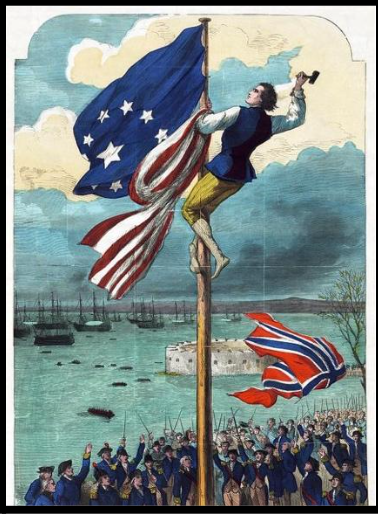
Washington had indicated he would not enter Fort George until the American flag was flying. In their haste to evacuate the Fort, the British had neglected to haul down the British standard. Or had they? On closer inspection, Washington’s advance troops found the flag had been nailed to the flagpole. Attempts to climb the pole proved to be ineffective because the British had removed the halyards, the ropes used to raise and lower the flag, and greased the pole! After three attempts to shinny up the pole ended in “sliding down,” calls for cutting down the pole were shouted out as confusion reigned. Finally, a volunteer placed cleats on his shoes and, aided with the use of a ladder, reached the top of the pole, ripped down the British flag, and hoisted the American flag
Finally, hearing the cannon salute, Washington, Clinton, and their entourage proceeded down Chatham Street to Pearl on to Wall Street and Broadway to Fort George, the streets lined with cheering throngs shouting approval of the city’s liberation. At Yorktown, the British had been humiliated by their defeat at the hands of a rag-tag, ill-clad army and militia, many in simple garments of homespun cloth, rough hunting shirts, and proper shoes, a sharp contrast to their well-appointed French allies and British foes. But in New York, on this day, the response to the unkempt, scruffy soldiers was one of jubilation. According to one observer, “We had been accustomed for a long time to military display in all the finish and finery…the troops just leaving us were as equipped for show with their scarlet uniforms and burnished arms…The troops that marched in, on the contrary, were ill-clad and weatherbeaten and made a forlorn appearance. But they were our troops, and as I looked at them and thought upon all they had done and suffered for us, my heart and my eyes were filled and I admired and gloried in them the more, because they were weatherbeaten and forlorn.”
That evening, Gov. Clinton hosted a dinner in honor of Washington and his officers at Fraunces Tavern, one of the finest in the city. Before the war, Fraunces Tavern had served as a meeting place for the Sons of Liberty as well as spies and intelligence networks. When the British took New York City in 1776, the tavern’s owner, Samuel Fraunce, fled to New Jersey, leaving his Loyalist son-in-law in charge of its operations. By 1783, Fraunce had returned.
On December 4, Washington gathered his officers in the Long Room on the second floor of Fraunces Tavern to thank them for their steadfast service, saying “with a heart full of love and gratitude, I now take leave of you. I most devoutly wish that your latter days may be as prosperous and happy as your former ones have been glorious and honorable.” Col. Benjamin Tallmadge later wrote, “Such a scene of sorrow and weeping, I had never before witnessed…that we should see his face no more in this world seemed to me utterly insupportable.”
After embracing each officer, Washington boarded the Whitehall Ferry for his trip to Annapolis where he would resign his military commission before the Continental Congress and then make his way to his home at Mount Vernon. In early 1785, the Confederation Congress leased Fraunces Tavern for office space for the Departments of Foreign Affairs and War and the Board of Treasury. As for Samuel Fraunce, he prospered and would later come out of retirement to accept the position of steward in the household of the first President of the United State, George Washington.