
More than sixty years after the first battle of the American Revolution, Ralph Waldo Emerson commemorated the clash between colonial patriots and British redcoats at the North Bridge in Concord, Massachusetts, on April 19, 1775, in his immortal poem Concord Hymn. “Here once the embattled farmers stood,” he wrote, “and fired the shot heard round the world.”
Patriots were not seeking independence. They were seeking redress of the grievances they had lodged against King George III and the British Parliament. Later, those grievances would be listed in the Declaration of Independence, but until then, independence was not on the minds of those resisting the strict regulations imposed on the British colonies hugging the shores of the Atlantic.
Months after the skirmishes at Lexington, Concord, and Bunker Hill (Breed’s Hill), the Continental Congress approved the Olive Branch Petition on July 5, assuring King George III of their loyalty and desire to avoid war. Delivered to the colonial secretary in London on September 1, it was too late. King George III had already declared the colonies to be in open rebellion and refused to read it. On December 1, the Continental Congress issued a response, noting they had always been loyal to the King, but that Parliament had no legitimate authority over them because the colonies were not represented in Parliament. Even then, they stated their hope to avoid “a civil war.”
Rebellion or the quest for “independency” did not come easily or quickly. Americans were by and large British in culture, political sentiments and history. It enjoyed many benefits of being a part of the world’s greatest empire. Pleading for redress of grievances was one thing; urging outright rebellion and being branded as a traitor was another – until January 10, 1776, when Common Sense was published and distributed throughout the colonies and beyond.
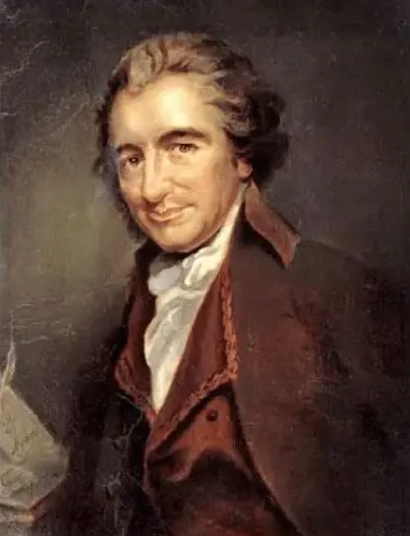
Written under the pseudonym “An Englishman,” its author was Thomas Paine, a failed businessman and exciseman in London who had immigrated to Pennsylvania only two years earlier, carrying a letter of introduction from Benjamin Franklin. Soon selected as editor of Pennsylvania Magazine, his essays began to attract attention from influential leaders. But Common Sense was anything but “common.” It swept the country just as the text of King George III’s recent speech declaring the colonies to be in open rebellion was being circulated in the colonies.
As Emerson’s Concord Hymn would later characterize the events of April 19, 1775, as “the shot heard round the world,” Paine’s Common Sense may unequivocally be described as “’the pamphlet heard round the world.” Its first printing of several thousand copies sold out in days. Additional printings sold just as quickly. Large excerpts were printed in newspapers and pirated editions soon appeared while additional editions were published in England and France. It sold 120,000 copies in three months and 500,000i by the end of the Revolutionary War.
Common Sense touched political nerves unlike any other in its time. Delivered in forty-six pages, Paine focused on the “violent abuse of power,” noting in his introduction that “the cause of America is, in a great measure, the cause of all mankind.” Rather than quoting ancient philosophers and writing in a style directed to the educated elite, Paine addressed the common man, writing as a journalist, not a theorist. In a style easy to absorb, he first addressed the role of government, asserting that “society in every state is a blessing, but government even in its best state is but a necessary evil; in its worst state an intolerable one.”
As an Englishman, he abhorred both the monarchy and the landed aristocracy, especially as they were based on hereditary succession. Why should one, by reason of birth, possess the right to rule over others? Even if one traces the lineage of a king, one discovers “nothing better than the principal ruffian of some restless gang.”
From his critique of monarchy and the English system, Paine turned to the American colonies and the necessity of a break with England, arguing forcefully for “referring the matter from argument to arms.” Questioning whether America had in fact flourished under Great Britain and her protection, he advanced the “brotherhood” with other Europeans and asserted that “the injuries and disadvantages” of association with Britain were “without number” and that “our duty to mankind at large, as well as to ourselves, instructs us to renounce the alliance” with them.
Common Sense changed the course of American history, and with it world history. George Washington called it “sound doctrine and unanswerable reasoning.” He found it “working a powerful change in the minds of many men.” John Adams agreed, suggesting that “without the pen of the author of Common Sense, the sword of Washington would have been in raised in vain.”
For Paine, his was the time “we have it in our power to begin the world over again,” truly a remarkable goal which he placed convincingly before an American generation. Common Sense was unquestionably “the pamphlet heard throughout the world.”