
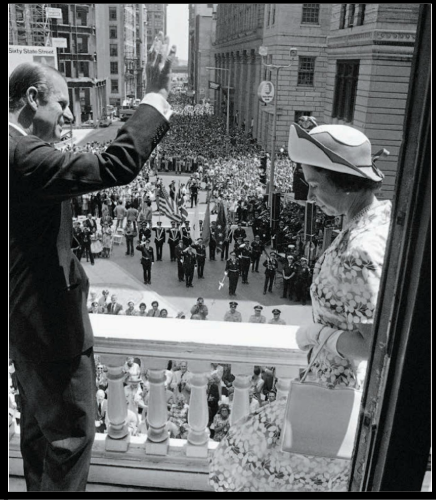
Queen Elizabeth II and Prince Philip – Balcony of the Old State House, Boston, 1776
On July 18, 1776, exactly two weeks after the Continental Congress approved the Declaration of Independence, Colonel Thomas Crafts stepped out onto the second-floor balcony of the Old State House in Boston. Since its construction in 1713, the building had served as the center of royal government in Massachusetts. Here, royal governors had been the voice of the kings of Great Britain, enforcing the law, managing colonial affairs (including taxation and military matters), and maintaining order. But the sentiments of the people, violent clashes between royal military authority and rebellious militias, and historic votes in Congress changed all of that.
As the crowd swelled and Bostonians were returning to the city after another outbreak of smallpox, Abigail Adams observed the historic event and described it a letter to her husband John, who remained in Philadelphia as one of five members of the committee designated to draft the document that was now to be read publicly to the people of Boston. Col. Crafts would announce what the people already knew – that “independency” from Great Britain had become a reality.
Crafts began reading at 1:00 p.m. “Great attention was given to every word,” Adams reported. “As soon as he ended, the cry from the balcony was God Save Our American States and then three cheers which rended the air, the bells rang, the privateers fired, the forts and batteries, the cannon were discharged…” After dinner, she continued “the king’s arms were taken down from the State house and every vestige of him from every place in which it appeared and burnt in King Street. Thus, ends royal authority in this State, and all the people shall say Amen.”
The King whose authority was so summarily dispatched was King George III, King of Great Britain and Ireland, whose reign dominated the high seas, Europe and India.
Two hundred years later, George III’s royal descendant and third great granddaughter, Elizabeth II, stood on the same second-story balcony of the Old State House responding to an enthusiastic and adoring crowd of Americans celebrating the bicentennial of the Declaration of Independence, which had enumerated twenty-seven specific complaints against her forebear.
Before arriving in Boston, the Queen had already visited Philadelphia and presented to Independence Hall a full-sized replica of the Liberty Bell, forged in the same English foundry as the original two hundred years earlier. Known as the Bicentennial Bell, it was a gift to the American people, inscribed with “Let Freedom Ring.” From Philadelphia, Elizabeth and Prince Philip traveled to Washington, D. C. for a dinner with President Ford at the White House, then to Capitol Hill and New York City, where the statue of George III had been torn down by a mob on July 9, 1776. After having been destroyed by rioting crowds wielding axes and hammers, the lead of the statue was sent to Litchfield, Connecticut, where people cast more than 42,000 bullets for the Continental Army.
Finally, the royal couple toured and lunched at Monticello, the home of Thomas Jefferson, whose Declaration of Independence accused Elizabeth’s precursor of “repeated injuries and usurpations” whose object was “the establishment of an absolute tyranny” over the American colonies.
But the Queen’s message, delivered during the presentation of the Bicentennial Bell, focused on our shared heritage, our common bonds, and British traditions that inspired the American experiment. “It seems to me,” she began, “that Independence Day, the Fourth of July, should be celebrated as much in Britain as in America. Not in rejoicing at the separation of the American Colonies from the British Crown, but in sincere gratitude to the Founding Fathers of this great Republic for having taught Britain a very valuable lesson.”
Britain lost the American colonies, she continued, “because we lacked that statesmanship ‘to know the right time, and the manner of yielding, what is impossible to keep.’ But the lesson was learned. In the next century and a half, we kept more closely to the principles of Magna Carta, which have been the common heritage of both countries. We learned to respect the rights of others to govern themselves in their own ways.” Without that, “we never could have transformed an Empire into a Commonwealth.” This was a message, she said, “in which both our people can join and which I hope will be heard around the world for centuries to come.”
On the 250th anniversary of the Declaration of Independence, King Charles III, the son and heir of Elizabeth II, and Queen Camilla will visit the United States as we count down to the historic date – July 4. At the invitation of Speaker of the House of Representatives Mike Johnson and other leaders of the House and Senate, King Charles will address a Joint Session of Congress on Tuesday, April 28, to “share one of the most consequential partnerships in history.” Let us welcome him!