We remember the Revolutionary War for its battles, generals, heroes, sacrifices, and most importantly, for the principles in the Declaration of Independence that inspired its success against all odds. Amid the smoke and chaos of the battlefield were the piercing notes of the fife and the steady rhythms of the drums signaling the troops to advance, retreat, or change field positions.
But beyond the battles and even beyond politics, there was music. Of course, songs were appealing to patriotism. In 1768, Founder John Dickinson not only wrote a celebrated series of “Letters From a Farmer in Pennsylvania” opposing new duties and taxes imposed on the American colonies by the British, but he also composed “The Liberty Song.” Responding to the seizure of John Hancock’s ship, Liberty, and Massachusetts’s protests against the Townshend duties, Dickinson sent his lyrics to a friend, noting that songs could be “very powerful on certain occasions.” Among the earliest of America’s patriotic songs, it was sung everywhere, set to the tune of the Royal Navy’s anthem, “Heart of Oak.” Its stirring words were sung as a resistance song – “Then join hand in hand, brave Americans all, by uniting we stand, by dividing we fall.”
Francis Hopkinson, a signer of the Declaration of Independence, is considered the first American composer, writing songs and political satires to foster the spirit of independence; but his musical talents began as a teenager when he learned to play the harpsichord and frequently performed concerts and played the organ at Christ Church in Philadelphia. Among his most popular songs was “My Days Have Been So Wondrous Fair,” composed in 1759. His “Temple of Minerva” was the first American attempt at “grand opera,” and his numerous hymns and psalms were well-received.
A lawyer and jurist by profession, Hopkinson was retained by the Second Continental Congress to design the Flag of the United States and was intimately involved in creating the Great Seal of the United States. Nevertheless, he found time to invent a new musical instrument, the bellarmonic, which utilizes the tones of metal balls, and to modify the glass armonica to be played with a keyboard.
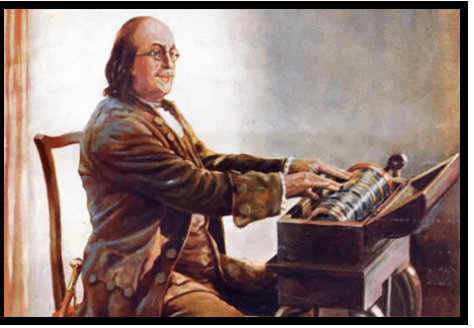
The glass armonica was actually invented by Benjamin Franklin while living in London in 1761. Inspired by hearing a friend playing on wine glasses filled with water (running a wet finger around wine glasses filled with water produces a high-pitched sound), Franklin’s armonica was made up of thirty-seven glass bowls of different sizes, which could be rotated on an iron spindle using a foot pedal. The instrument became so popular that Mozart, Beethoven, and Handel wrote works for it. Among luminaries who learned to play it were Marie Antoinette, the future queen of France, as well as the future queens of Naples and Spain. For Franklin, he said that of all of his inventions, the glass armonica gave him “the greatest personal satisfaction.”
Among other delegates to the Second Continental Congress, Thomas Jefferson loved music. A skilled violinist, he frequently attended and played in concerts as a student at the College of William and Mary and performed with others, including Patrick Henry. Throughout his life, he owned various instruments, including a harpsichord, guitar, several violins, and a “kit.” A kit was a miniature pocket violin frequently used by dance masters. Jefferson would attach a kit to his saddle when traveling by horseback. His love for music grew with his years in Europe, where he met Mozart and collected 6,500 pieces of sheet music, which eventually became the nucleus of the Library of Congress.
Jefferson recorded that music was “the favorite passion of my soul.” It has been said, but not confirmed, that Jefferson would pause and play his violin to help clear his mind while drafting the Declaration of Independence. However, his playing with Patrick Henry was well-known.
Before becoming a self-taught lawyer and orator rising to patriotic heights with his “give me liberty or give me death” peroration during the Second Virginia Convention in March 1775, Henry was a popular fiddler at Hanover Tavern. Situated directly across from the Hanover Courthouse and owned by Henry’s father-in-law, the tavern had a bustling clientele where Henry served as a bartender and regaled customers with his lively fiddle and Scottish ballads. While Jefferson learned to play the violin under a teacher, Henry played by ear and was considered “an excellent performer on the violin.” He also learned to play the flute, the English guitar, and the harpsichord.
George Washington, too, loved music and his graceful skill as a dancer was widely known and appreciated by the ladies who enjoyed being his dancing partner. Although he did not personally play a musical instrument, songs were sung about him. Among the first were verses adapted to the British satire of ragtag American militia, including the at-the-ready Minutemen. “Yankee Doodle” was originally a military mockery of Americans but was soon coopted into a patriotic anthem. The earliest known Patriot version was composed by Edward Bangs, a Minuteman, in 1775 or 1776.
Bangs’s verses are the ones most remembered today – “Father and I went down to camp, along with Captain Gooding. And there we see the men and boys as thick as hasty pudding. Yankee Doodle keep it up. Yankee Doodle dandy. Mind the music and the step, and with the girls be handy.” Later, the troops hailed their commander-in-chief with this Yankee Doodle verse, “And there was Captain Washington and gentle folks about him; they say he’s grown so tarnel proud he will not ride without him.”
There is so much more to the Founders’ Soundtrack and the beginning of the American Songbook.
USA250-OC#51