
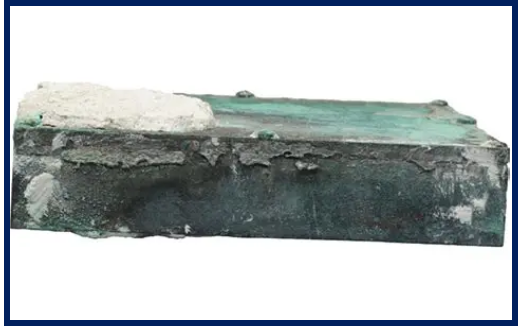
Time capsules haven’t been around that long, the earliest known found in Poland, dating to about 1721. Today it is estimated that there are between 10,000 and 15,000 time capsules around the world, each facing two existential issues: preserving their contents from deteriorating and remembering over time where the time capsules were placed.
According to the International Time Capsule Society (yes, there is such an organization) more than 80% of all time capsules are lost and will not be opened on their intended dates. This was certainly true about a time capsule created by two of our Founding Fathers and may become a problem for a new time capsule to be buried in Philadelphia on July 4, 2026.
Let’s begin on a cold, snowy, mid-December day in Boston in 2014 when construction workers were repairing a leak in the historic Massachusetts State House. Spotting something unusual near the building’s cornerstone, they notified the Boston Museum of Fine Arts (MFA). After the cornerstone was carefully removed, one of the museum’s conservators, Pam Hatchfield, slid into a small dark space, lying on her back as she painstakingly chiseled the plaster encasing a capsule placed there nearly 130 years earlier. She labored for nearly seven hours, taking periodic breaks from the cold wind and snow before prying loose a 10-pound greenish, corroded, brass box – a time capsule.
A month later, on January 6, 2015, the MFA and Commonwealth of Massachusetts opened the capsule. A hushed crowd of journalists and public officials watched as Hatchfield spent several hours opening the capsule, aided by an arsenal of delicate equipment which included a porcupine quill and her grandfather’s dental tools. Just removing the screws securing the lid in place took five hours.
One by one, with deliberate care, the contents of the capsule were removed. The first to be revealed were objects placed in the box in 1855, the first time the capsule had been accidentally discovered. In an ironic coincidence of events, similar to those in 2014, workers making repairs to the foundation of the State House in 1855 had discovered a cowhide pouch, placed there in 1795 by Governor Samuel Adams and Paul Revere, Grand Master of the Massachusetts Freemasons.
The occasion had been the laying of the cornerstone of the new State House on July 4, 1795, celebrated with “more than usual magnificence.” The day had begun by the ringing of bells, a military salute, and an oration at the Old South meeting house, followed by a procession in which the cornerstone was drawn to its new home by fifteen white horses (one for each State of the Union) decorated by colored ribbons, federal emblems and other insignia. The makeshift “time capsule” was placed in the excavated soil below the cornerstone, undiscovered until sixty years later, on August 7, 1855.
The pouch was opened, inspected by an antiquarian, and placed in a new, more durable brass container, but not until added to its contents were silver coins of 1855 U.S. currency;, an impression of the State seal; the title page of the first volume of the newly printed Massachusetts Colony Record; and morning newspapers. Unlike the pomp and circumstance attending the 1795 ceremony, the replacement was quiet and unostentatious, witnessed by Governor Henry Gardner and other officials. Once again, the time capsule was sequestered under the foundation of the State House, its irreplaceable relics secured, and for a second time lost to history, rediscovered on December 11, 2014
Pam Hatchfield opened the box, first removing its most recent contents, placed there in 1855. Then she removed a worn rawhide pouch, finding its contents in remarkably good condition – a coin minted in 1652; coins from the1780s; the title page from the Massachusetts Colony Records; a medal honoring George Washington struck in England in 1794; and pages of magazines of the era. Finally, an engraved silver plate, probably created by Paul Revere, engraved with the names of its depositors, Governor Samuel Adams, Masonic Grand Master Paul Revere, and Deputy Grand Master William Scolly.
The contents of the capsule remained on public display at the Boston Museum of Fine Arts for several months, then reseated in its historical resting place in a ceremony recreating the mood of 1795 with four Clydesdale horses bearing the replica of a cornerstone, a 19-gun salute, and hundreds of Freemasons in procession as a fife and drum corps played.
And the future? America 250, the national organization charged by Congress to lead the 250th anniversary of our country’s founding, has designed “America’s Time Capsule.” To be buried near Independence Hall in Philadelphia on July 4, 2026, and remained sealed until 2276 – two hundred years from now.
ITS FATE WE WILL NEVER KNOW!