
On July 2, 1776, the Second Continental Congress declared thirteen of Britain’s twenty-six North American colonies to be independent. Two days later, they provided the reasons for that separation in the Declaration of Independence. Each colony then drafted new constitutions and joined together under the Articles of Confederation – a compact of the newly independent states.
Unfortunately, the compact was wholly inadequate to meet the needs of the nascent nation. By 1787, the states demanded a convention to amend the Articles because they had created a government too weak to solve economic chaos, interstate conflict, foreign-policy humiliation, and domestic unrest – problems that made national survival doubtful.
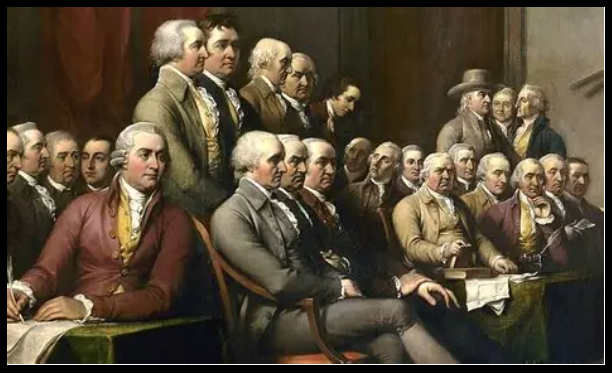
Declaring and winning independence was a very different challenge than the problem of governing a new nation – especially one composed of individual states, each jealous and protective of its own interests. It also called for a different way of thinking to address the thorny and contentious issues of governing, but the men who convened in Philadelphia in the summer of 1787 brought with them experience suited to the task. Eight of them had signed the Declaration of Independence, 25 had served in the Continental Congress, 15 helped draft new State Constitutions between 1776 and 1780, and 40 had served in the Confederation Congress between 1783 and 1787.
Of course, those whom we know so well were there. Benjamin Franklin. James Madison. George Washington. Washington was immediately elected President of the Convention and Madison’s role earned him the appellation “Father of the Constitution.” Other lesser-known but essential delegates included Elbridge Gerry (remember “gerrymandering?”), Robert Morris, and John Dickinson. Then there was William Few, Luther Martin, Daniel of St. Thomas Jenifer (yes, that really was his name), Jonathan Dayton (the youngest delegate), and forty-five others whom most Americans will never know.
Although Thomas Jefferson, serving as ambassador to France, called these fifty-five men “an assembly of demi-gods,” they were ordinary men, with ordinary gifts and faults, who created one of the world’s most extraordinary documents – the United States Constitution. They harbored personal and political jealousies, political opinions, and diverse interests. They were at times inconsistent as well as altruistic. In short, they were much like the leaders of our country today – and like you and me. They were human. But, as noted by John Kaminski, America’s foremost researcher on our founding, they were motivated by “a remarkable sense of duty.”
Early in its struggles against Britain, John Adams noted the necessity of knowing “the character of every man,” to “penetrate into the minds of men and discover their secret passions, prejudices, habits…” in order to judge how they will act in the future. They needed to size up their compatriots. This was no less true during the Constitutional Convention.
William Pierce, representing Georgia, actually drew up “character sketches” of his fellow delegates, offering rare personal insights into their personalities, reputations, and rhetorical styles. More than just biographical notes, they are personal, primary source portraits that enrich our understanding of the men who argued, debated, and finally drafted the Constitution. Unpublished until 1828, Pierce’s sketches are pithy, at times humorous, and strictly his own – and worth reading.
Not surprisingly, he observed that Benjamin Franklin “tells a story in a style more engaging than anything I ever heard.” Alexander Hamilton, by contrast, had too “feeble” a voice for oratory, but is a “convincing speaker.” The same he would say of James Madison, whose strength was being “the most informed man of any point in debate.” Roger Sherman, largely credited with the Connecticut Compromise which saved the Convention from dissolving, spoke “with that strange New England cant which runs through his public as well as his private speaking” and makes everything he says “grotesque and laughable.” Nevertheless, he “deserves infinite praise – no man has a better heart or clearer head.”
To Pierce, the man most “clear, copious and comprehensive” but “no orator,” was Pennsylvania’s James Wilson who “ranked among the foremost in legal and political knowledge.” Gouverneur Morris, on the other hand, was “fickle” and “inconstant,” winding through “all the mazes of rhetoric,” but no one could “engage the attention” more than him, even as he had been “unfortunate in losing one of his legs.” George Read’s oratory was “fatiguing and tiresome to the last degree.” Maryland’s Luther Martin, known to enjoy his alcohol, “never speaks without tiring the patience of all who hear him.” There was “nothing remarkable” about James McHenry but who was, however, “a very respectable young gentleman.”
Do these sketches matter? Just think about your own observations concerning your friends or people with whom you work. How do you view them – both their admirable and less worthy qualities? Yes, it matters, and how our Founders viewed and interacted with each other offers insights into the human side of the Convention. Pierce’s sketches are not only his personal descriptions of others, but short bios worth reading. You can find them at https://www.consource.org/document/william-pierce-character-sketches-of-delegates-to-the-federal-convention/.
USA250-OC#54