
New Year resolutions are nearly as old as recorded history, harkening back to the ancient Babylonians more than 4000 years ago. What has changed is the date of the new year itself. In those earlier times, the spring planting season was considered the beginning of the year. That was when promises were made to pay debts, return borrowed farm equipment and other resolutions suitable to an agricultural society.
The Romans adopted the tradition of resolution-making, but about 45 B.C. Julius Caesar introduced the Julian Calendar and set January 1 as the official beginning of the year. Through the centuries people continued to make resolutions, a common theme being self-improvement. Unfortunately, keeping resolutions is not nearly as easy as writing them. Studies reveal that only about 25% of people actually stay committed to their resolutions after just thirty days. Less than 10% accomplish their goals. Why such a miserably low success rate? Primarily because people never turn their resolutions into habits!
No one understood this problem better than Benjamin Franklin. In fact, he made a resolution about resolutions and devised a plan to measure his progress. It all began when he was a young man and decided to embark on the “arduous project of arriving at moral perfection.” For Ben, that meant being a “doer of good.”
Having read many ancient and current philosophers, he began by making a list of virtues that would help him achieve his goal. He would briefly describe each one. For example, of the virtue of TEMPERANCE he wrote, “Eat not to dullness; drink not to elevation.” Similarly, of SILENCE he wrote, “Speak not but what may benefit others or yourself; avoid trifling conversation.”
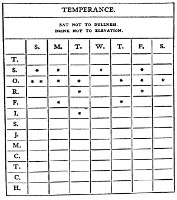
After reviewing his list of thirteen virtues, Ben realized that working on them one at a time would be more effective and efficient than working on all of them all at once. Hence, his plan. He made a small paper book with a page for each virtue. At the top of each page, he printed the name of one virtue. Then, he ruled each page, making seven rows across each page, one for each day of the week. Finally, he made thirteen columns, down the page – one for each virtue.
Each day he would review his list, making a small mark in the columns of the virtues he had violated. But for the entire week he would give special attention to the first virtue, trying as hard as he could to strengthen that virtue. The second week, he would follow the same routine, except that he would concentrate on the second virtue. He would continue the process until he had worked hard on each virtue for an entire week, all the while grading himself daily on whether he had lived up to all of the virtues. Ben’s goal was to have as few check marks in his book as possible. He could actually go through this process four times a year!
Ben used the little paper book over and over, erasing marks, adding new ones, and erasing more. Soon it was full of little holes from all the marking and erasing, so he finally made a new book with pages made of ivory. Using a special lead pencil, he could easily make marks erasable with a damp sponge, much like a modern dry erase board.
Ben’s project was successful because he understood the power of habit. Wanting to be virtuous is not enough. You must decide to be virtuous, learn about virtue and practice it. To obtain virtue, you have to practice being virtuous until being virtuous becomes a habit.
Ben added one more simple activity to his quest for moral perfection. Each morning, he would ask himself, “What good shall I do this day?” At the end of the day, he would ask, “What good have I done today?
Ben carried his little book with him throughout his life. He admitted he “never arrived at the perfection I have been so ambitious of obtaining…yet I was a better and happier man than I otherwise should have if I had not attempted it.”
One of Ben’s virtues was RESOLUTION – Resolve to perform what you ought; perform without fail what you resolve. To learn more, read the Autobiography of Benjamin Franklin.