
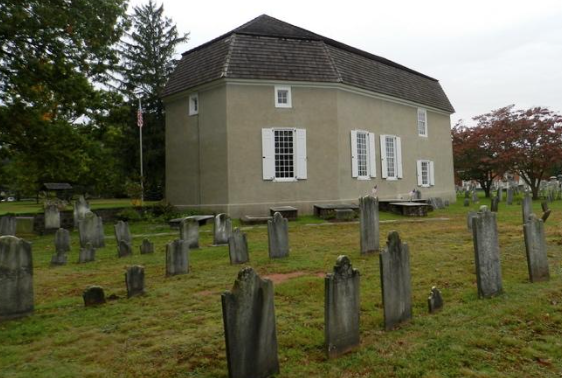
It was September 11 and the sounds of destruction could be heard thirty miles away. That morning, the pastor of Augustus Church recorded in his journal that the sounds of violence were “heavy and long continuing.” But they were not the result of planes crashing into World Trade Center skyscrapers. They emanated from the clash of “two armies engaged in a hard struggle” near Brandywine Creek in Pennsylvania. The year was 1777.
General George Washington was losing yet another battle as the British Army set its sights on Philadelphia. The town of Trappe and the roads leading in and out were filled with refugees and soon to be overflowing with soldiers, first Continentals and days later with British. It was impossible to maintain law and order. “No place is safe,” the pastor wrote several days later. “Where the two armies do not go, one finds thieves, robbers, and murders.” Even his own home was not spared as demands for food and shelter were continually demanded, at times at gunpoint.
The pastor, Henry Melchior Muhlenberg, had one additional reason to fear. He sincerely believed a churchman should not take up arms and remained neutral, even though his oldest son was a brigadier general in the Continental Army, embroiled in the madness surrounding them. He could easily be targeted by one side or another – as a Patriot or a Loyalist.
Muhlenberg was born in the Electoral Principality of Hanover where many of its citizens had been among the early followers of Martin Luther. A short time after being ordained a Lutheran minister, he was assigned to Pennsylvania to oversee fledging Lutheran congregations. The trip from Hanover through London was a difficult one and made no easier when he arrived in Philadelphia to scenes of the slave trade which, he noted, “will entail a severe judgment.”
Later known as “the Father of Lutheranism in America,” Henry’s assignment was not an easy one. It required pastoring three churches miles apart, riding circuit and mediating intense personal and theological disputes. But when he fell in love with Anna Maria Weiser, his burdens became increasingly more bearable and lived to see three of his sons follow in his footsteps as pastors in the Lutheran Church.
John Peter Gabriel, Henry and Anna’s first son, was born October 1, 1746, followed by Friedrich Augustus on January 1, 1750. Among the eleven children in the Muhlenberg household was the third son, Gotthilf Henry Ernst, born on November 17, 1753. All three were sent to their father’s home in Hanover for schooling, not without controversy. But, as one observer noted, they were “boys all right! But they were America boys, not German, not English, not European.”
In May 1771, Peter received an invitation to pastor a parish in Woodstock, Virginia, in the Shenandoah Valley. However, Peter was a Lutheran and Anglicanism was the official church in Virginia. Only a person ordained in the Anglican Church could legally preach and collect tithes from his congregation. Months later, Peter sailed for London, was ordained an Anglican priest by the Bishop of London and returned to his new home and pastorate in Woodstock.
As tensons between the colonies and Great Britain escalated, Peter was selected as Chairman of the Committee of Correspondence and Safety in Dunmore County. Later he attended the Convention held in St. John’s Church in Williamsburg where Patrick Henry delivered his “give me liberty or give me death” oration. But his most dramatic and fiercely patriotic moment took place in January 1776. Although there are variations in details, he preached that this was the time to fight and led many men of his congregation as a Lieutenant Colonel, then later as a brigadier general in the Continental Army. Later he would serve as a member of the House of Representative and United States Senator.
In the meantime, Friedrich and his family fled their parish in New York City to escape British bombardment of the city. Returning to Pennsylvania he was elected to the Continental Congress and, to the chagrin of his father who prayed his son would not “be led into temptation,” continued a life in politics. He would go on to chair the Pennsylvania convention to ratify the Constitution, be elected to the House of Representatives and serve as its first Speaker. In that capacity, he would be the first to sign the Bill of Rights.
Like his brothers, Gotthilf supported the Patriot cause, but in a less overt capacity. He served as pastor in several congregations in the Philadelphia area but was forced to flee when the British occupied the city. Three years later he moved to Lancaster, Pennsylvania, and spent the remainer of his life as pastor of Holy Trinity Church and diving deep into the study of botany, earning international acclaim for his work. When German-speaking Pennsylvanians sought to create a college in 1787, they chose Gotthilf as the first President of Franklin College.
The “Old Trappe Church,” founded in 1742 by Henry Melchor Muhlenberg stands today as the oldest Lutheran church building in continuous use in the United States. Like the church, Henry’s legacy endures.