
The reply to her letter of December 23, 1789, arrived from New York in early January. It was dated January 6, 1790, and signed by the newly elected President himself – George Washington.
Shortly after his inauguration on April 30, 1789, Washington had confided to a friend that he anticipated “one of the most difficult and delicate parts of the duty of my office will be that which relates to nominations for appointments.” Eighteen months later he would express his frustration to former General John Armstrong, writing that dealing with appointments was “difficult and painful in the extreme…the most irksome part of the Executive trust.”
Armstrong was among the multitude of people sending letters of recommendation to the President for the even greater number of people seeking positions in the new federal government, which had become a reality on March 4, 1789. The new government needed a workforce, most of it to be lodged in the executive branch to carry out both domestic and foreign policies. The number of jobseekers far exceeded the number of positions available, and Washington was immediately deluged with applications.
But Mary Katherine Goddard was not seeking a position in the new government. She was simply appealing to the President to reinstate her to a position she had held for fourteen years. More than two hundred thirty principal merchants of Baltimore signed a petition supporting her plea.
Born in Connecticut to a successful doctor who was also the town’s postmaster and an educated, entrepreneurial mother, Mary Katherine was actively engaged in the family’s printing business, including managing the Maryland Journal in Baltimore while her brother William engaged in a number of less-than-profitable enterprises. Like her brother, Mary Katherine was a Patriot, reporting on the British blockade of Boston and other British oppressive actions and encouraging women to join the “homespun movement” to boycott British goods, embrace frugality, and rely on domestic flax, wool, and other products. The Atlantic Journal was among the first colonial newspapers to report on the Battle of Bunker hill in June 1775.
Later that year, when the Continental Congress adopted William’s proposal for a national postal system independent of British control, Mary Katherine was appointed postmaster for Baltimore. During the Revolutionary Way, the cash-strapped Continental Congress was often unable to pay her, so Mary Katherine paid for the post-riders herself, assuring the mail would get to its destinations. She even bartered with her subscribers, taking flour, butter, meat, and other commodities instead of money.
In December 1776, as British forces chased Washington and his army out of New Jersey, only thirty miles from Philadelphia, the Continental Congress packed the Declaration of Independence into a wagon and evacuated to Baltimore. Suddenly, Mary Katherine was responsible for mail to and from Congress, printing important documents and broadsides, as well as managing the Maryland Journal, her bookstore, and print shop – all located within blocks of the place where Congress was meeting.
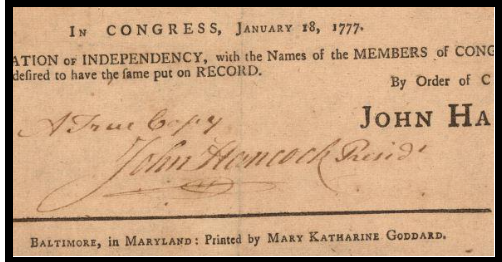
On Christmas Eve, Washington led his rag-tag army across the Delaware River and launched a successful surprise attack on the British-backed Hessian soldiers encamped at Trenton, sparking new hope that the war for independence could, indeed, be won. Weeks later, Congress ordered that an “authenticated copy” of the Declaration of Independence, “with the names of the members of Congress subscribing to the same,” be printed and sent to each of the States. For the first time, the names of the signers would be made public. Mary Katherine was selected as the printer.
For some time, Mary Katherine had stopped printing the Maryland Journal under her absent brother’s name and began citing “M. K. Goddard” as its publisher. But this changed on January 18, 1777, when she would place her own name on the Declaration of Independence; not as a signer, but a printer, thus placing herself in the same precarious position to be labeled by the British as a traitor.
After the Revolutionary War, William resumed control of the paper and forced his sister out of the business, resulting in a life-long estrangement. Nevertheless, Mary Katherine continued to operate as a seller of books, dry goods, and stationary, and as Baltimore’s postmaster – until 1789 when the nation’s newest postmaster replaced her with a political ally, claiming that the position would require “more travelling that might be necessary than a woman could undertake.”
Washington refused to intervene but responded in his January 6 letter that he had “uniformly avoided interfering with any appointments” not requiring his official agency, but “giving power to the Postmaster General to appoint his own deputies and making them accountable for their conduct.” Mary Katherine’s petition to the United States Senate went unanswered.
Mary Katherine never married but continued to manage her business until her death in 1816 at the age of 78. Upon her death she freed her slave, Belinda Starling ,and bequeathed to her all of her property in “recompense for the faithful performance of duties to me.”
Mary Katherine Goddard – the only woman’s name to grace the Declaration of Independence.
USA250-OC#60