The weather in Philadelphia in May can be unpredictable. This morning, May 10, 1876, was no exception. At sunrise, the bell in the tower of Independence Hall rang out and was soon joined by bells and chimes throughout the city for half an hour as the rain gently covered the earth. This was the formal announcement of the Centennial holiday. By the time the gates were opened at 7:00 a.m., the rain was steady but gentler, finally ceasing altogether.
An hour later, President Ulysses S. Grant, accompanied by Gov. John Hartranft and escorted by seventy-five men of the First City Troop, arrived in a carriage drawn by four grey horses. The platform for the President, his Cabinet, the Emperor of Brazil, the diplomatic corps, and a wide variety of other dignitaries was capable of holding 4,000 people. Generals William Tecumseh Sherman and Phil Sheridan were among the thousands who heard the new Centennial Hymn by John. G. Whittier and the Centennial March composed especially for this event by German composer and conductor Richard Wagner.
History records that President Grant took “some manuscript from his coat-tail pocket, with modest demeanor and, in still more modest tone of voice, proceeded to read his speech.” He began slowly, “One hundred years ago our country was new, but partially settled.” When he reached his conclusion, he simply declared that the Centennial Exhibition was “now open.” Until that date, there had never been anything of this scale produced in the United States. Its purpose was to celebrate the 100th anniversary of the Declaration of Independence and the birth of the United States.
When the Exhibition closed on November 10, more than 10 million people would have attended, meandering through more than 200 buildings and pavilions and patronizing 30,000 exhibitors at a cost of approximately $10 million. The exhibition was not without controversy, including funding. Congress had created the Centennial Commission in 1871, provided that the federal government would not be liable for any expenses. The Centennial Board of Finance was authorized to sell up to $10 million worth of shares and both the City of Philadelphia and the State of Pennsylvania contributed, but more was needed.
The Board’s President, John Walsh, then enlisted the help of the women of Philadelphia with whom he had worked before. Forming the Women’s Bicentennial Executive Committee under the leadership of Elizabeth Duane Gillespie, a great-granddaughter of Benjamin Franklin, the group quickly raised $40,000. However, when they learned there was little about women to be included, they raised more money for a women’s pavilion, the first at an international exposition to focus on the work of women.
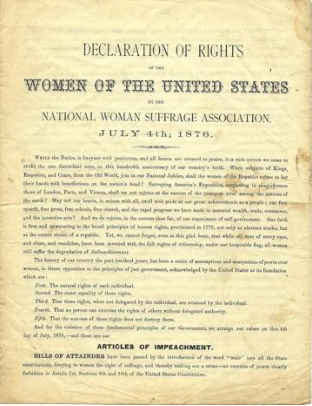
In the meantime, the National Women’s Suffrage Association petitioned to participate in the July 4 centennial ceremony and read the Declaration of Rights of the Women of the United States.” Originally written in 1848 by Elizabeth Cady Staton, Susan B. Anthony, and others, it parroted the language and structure of the Declaration of Independence, beginning with, “When, in the course of human events…We hold these truths to be self-evident, that all men and women are created equal.” Modified for the 1876 celebration, its preamble asserted that “all women still suffer the degradation of disfranchisement.” Both versions contained a list of grievances from denial of trials by their peers, taxation without representation, and more. In short, women were not full citizens.
Gen. Joseph R. Hawley, Chairman of the Commission, denied the women’s request but attempted to placate them by providing six tickets to the July 4 ceremony, explaining that the program for the day was already too crowded. The six tickets were in the audience, not on the platform as requested.
As the program proceeded, Richard Henry Lee (whose grandfather had made the motion for independence in the Continental Congress in 1776) read the Declaration of Independence aloud from the very piece of paper signed in 1776. Seated on the platform with Lee and other was Thomas Ferry, president pro tem of the United States Senate. As Lee concluded his reading, Susan B. Anthony and four women rose, approached the platform, and presented their Declaration to Ferry while Hawley protested, shouting, “Order! Order!”
Anthony and her followers exited where the ceremony was taking place, walked around the building to the front of Independence Hall, and read the Women’s Declaration to a gathering crowd as copies were distributed. “We ask justice,” she declared. “We ask equality. We ask that all the civil and political rights that belong to citizens of the United States be guaranteed to us and our daughters forever.” Those demands would finally be realized when the Nineteenth Amendment to the Constitution was ratified on August 18, 1920.
As for the Centennial Exhibition and Celebration…it was an overwhelming international success!