
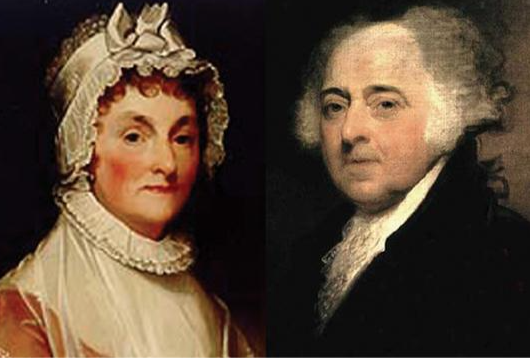
When John Adams first met Abigail Smith, he wasn’t impressed. She was only fifteen years old, and he was eight years her senior. Besides, John had an interest in Hannah Quincy, about whom he wrote in his earliest diary, “That face, those eyes.” About Abigail he wrote, she was seriously lacking in “fondness” and “tenderness” when compared to Hannah. However, as time went by, Hannah married someone else, to John’s great regret. But before long, he knew “he had done his best and had no further regrets.”
In the meantime, Abigail was growing into an attractive, slender young woman. One of John’s best friends began courting Abigail’s older sister Mary as well as acting as an informal mentor to Abigail, teaching her French, loaning her books and discussing English literature. In an age when women’s interests were generally confined to home, hearth, and children, Abigail’s father encouraged his daughters’ education and passed to them his insatiable passion for reading. Abigail became a voracious reader. John took notice and was soon bringing books to Abigail on his own.
The twenty-seven-year-old attorney and the eighteen-year-old soon began a correspondence that would last the rest of their lives, John endearingly signing his letters “Lysander” and Abigail as “Diana,” a nod to their mutual interest in classical mythology. His opinion of Abigail had decidedly changed. Confiding in his diary, John recalled the events of his day on the first of February 1773. “Di was a constant feast,” he wrote. “Tender feelings, sensible, friendly. A friend. Not an imprudent, not an indelicate, not disagreeable word or action. Prudent, modest, delicate, soft, sensible, obliging active.” Their mutual attraction and romance advanced quickly.
Abigail was anticipating a spring wedding, but plans were delayed due to an outbreak of smallpox in Boston. Although their families lived in and around rural Braintree and Weymouth where epidemics seldom spread, John’s legal work required that he spend a great deal of time in Boston. Severe outbreaks of smallpox had broken out in Boston in 1721 and 1752, with a mortality rate of up to 50% and survivors facing disfigurement, ostracization and long-term health issues. News of smallpox created panic throughout the city and wherever it raised its ugly head.
Years earlier, Rev. Cotton Mather had a slave named Onesimus who described having been inoculated against the disease as a child in Africa. Mather was also familiar with descriptions of the practice in Constantinople and convinced Dr. Zabdiel Boylston to inoculate his own son and two of his slaves. Inoculation involved deliberately infecting a person with a mild form of smallpox to induce immunity. A great controversy surrounded the procedure, especially when it could lead to severe illness or death. The community was bitterly divided. Among those siding with Mather and Boylston was Benjamin Franklin’s older brother James whose paper, the New England Courant, weighed in on the debate.
Later, George Washington would contract smallpox while visiting Barbados with his half-brother, leaving some slight scarring but providing him with immunity from further attacks. He would eventually require that soldiers in the Continental Army be inoculated.
But now, in 1764, to protect himself and his prospective family, John Adams decided to be inoculated. Abigail wanted to go with John and be inoculated, but her mother objected. But the correspondence continued, John writing to his “Diana,” advising her not to “conclude from anything I have written that I think inoculation is a light matter.” It was deadly serious.
Near the end of his treatment and confinement, John wrote to Abigail, noting he had earlier promised “a catalogue” of her “faults, imperfections, defects, or whatever you please to call them. Then, astonishingly, he proceeded to number them and provide details! 1. She had not, he wrote, learned to play cards well. 2. She was too informal in company where “a certain modesty” and “bashfulness” is more appropriate. 3. She had not learned to sing. 4. She did not sit erect, probably because she spent too much time reading. 5. She sat with the “leggs across,” which “ruins the figure” and probably comes from “too much thinking.” 6. She walks “with the toes bending inward.” 7. He closed with a rosy summary; he had “studied for more” but “more are not to be discovered. All the rest is bright and luminous.”
Abigail’s response came quickly – two days later. With a note of sarcasm, she noted she would avoid any behavior which would “render me unfit to herd even with the brutes.” As for singing, she claimed to have “a voice as harsh as the screech of a peacock.” Frankly, she opined, “a gentleman has no business to concern himself about the leggs of a lady” while her walking pigeon-toed could be cured “only by a dancing school.”
In short, Abigail could give as good as she got. She closed her brief missive promising not to add to her faults “that of a tedious letter.”
Abigail Smith and John Adams were married on October 25, 1764. Through correspondence for the next fifty-four years, we learn of their deep and abiding affection, the strength of their long union, and her role as his primary political adviser as well as partner in life. Their correspondence can be read at Founders Online. You will not be considered an intruder; you will be learning history by those who made it.