
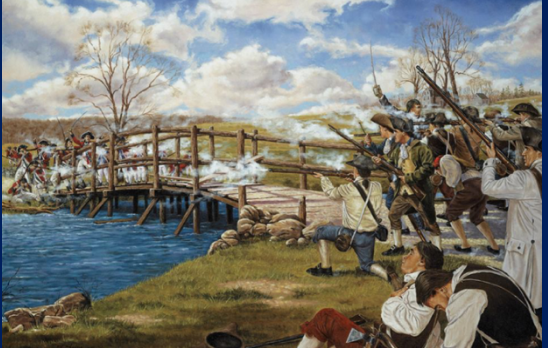
Writing to newspaperman and publisher Hezekiah Niles in February 1818, former President John Adams asked and responded to his own question. “What do we mean by the American Revolution?” he asked. “Do we mean the American War? The Revolution was effected before the War commenced. The Revolution was in the minds and hearts of the people.”
Adams was right. The seeds of separation from Great Britain were planted nearly twenty years before “the shot heard round the world” was fired on the green in Lexington, Massachusetts on April 19, 1775. Relations between Britain and her North American colonies deteriorated as Britain imposed new taxes, regulations, and restrictions wholly unacceptable to a people who had increasingly become accustomed to governing themselves and managing their own affairs.
Both sides of the dispute endeavored to reconcile their differences. Even months after Lexington and Concord the Continental Congress sent the Olive Branch petition to King George III in hopes of avoiding war. However, hostilities had already begun, and the king refused to read the petition, declaring the colonies were in rebellion and the colonists were traitors.
To this day, no one knows who fired the first shot – a British Redcoat or a Patriot Militiaman. Both sides denied initiating the conflict. Nor was this their first violent encounter. Five colonists had been killed when British soldiers fired into a crowd in Boston in 1770. Later, Patriots dumped fifteen tons of British tea into Boston Harbor. Months before Lexington, patriots stormed Fort William and Mary in New Hampshire and seized the garrison’s gunpowder, ammunition, heavy cannon and other supplies. Shots were exchanged but the skirmish did not lead to war.
But the events at Lexington and Concord were different and the pressure between Britain and the colonies was at a boiling point. The British had been ordered to search and confiscate gunpowder stores believed to be held in Concord. Knowledge that rebel leaders John Hancock and Samuel Adams were in Lexington raised the stakes. Alarmed at the possibility of their arrest, Joseph Warren sent Paul Revere, William Dawes, and others to alert the two men and the countryside that the “Regulars” – British troops – were on the march.
Although professionally trained and vastly outnumbering the colonials, the British force of 700 men was not prepared for how quickly the countryside could muster its militia and the battle tactics they would employ. The patriots had been training and were prepared to respond to threats “at a minute’s notice.” By the time they reached Concord, the British found they were now outnumbered and began a retreat, facing harassment from “Minutemen” at every turn.
Finally, more than a thousand British reinforcements arrived under the leadership of General Hugh Percy, who shared the prevailing British belief that the colonists were “cowardly and would never fight the Crown.” They were “raw, undisciplined, cowardly men,” the “most absolute cowards on the face of the earth.” But they had never encountered men such as 80-year-old Samuel Whittemore.
Whittemore had fought against the French in 1745 as a Captain in His Majesty’s Dragoons and later volunteered in a colonial regiment in the French and Indian War. But he loved liberty and wanted his descendants to live in a country independent of a distant king, and where people could govern themselves. He was ready to fight for it.
At work in the fields on his farm on April 19, Whittemore spotted Percy’s relief brigade. Hearing about the fighting at Lexington and Concord, he grabbed his musket, two pistols, and his sword and chose a position behind a wall on Mystic Street in the town of Menotomy (now Arlington). Refusing pleas from his fellow Minutemen to move to a safer location, he stood fast as the retreating Redcoats approached.
Waiting until the British troops were directly in front of him, Whittemore stood and fired his musket, killing one of them. Then he fired his pistols, killing one soldier and mortally wounding another. With no time to reload his pistols or musket, he drew his sword and began slashing away as bayonet-wielding soldiers surrounded him. A soldier leveled his musket at Whittemore, striking him in the cheek with a .69 ball. Overpowered, he continued to fight, flailing with his sword until clubbed in the head by the butt of a musket and stabbed with bayonets thirteen times before being left for dead.
As the Redcoats continued their retreat, townspeople ventured out to retrieve their dead and wounded. Several had witnessed Whittemore’s valiant stand and were astonished to find him alive – not only alive but conscious and still trying to load his musket. Carried to a temporary emergency room at Cooper Tavern, he was treated by Dr. Nathaniel Tufts, who declared Whittemore should have bled to death, bandaged his wounds, and sent him to his home to die.
But Whittemore had other ideas. He lived another eighteen years, dying at the age of 98, having witnessed the final victory over the British, ratification of the Constitution, and the inauguration of George Washington as President of the new Unted States of America.