
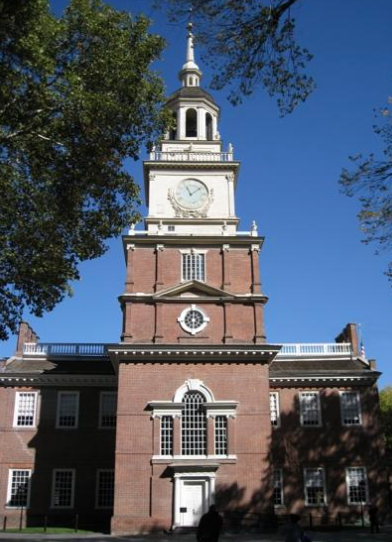
At 4:30 p.m. on Saturday, April 22, 1865, a train draped in black bunting pulled slowly into Philadelphia’s Broad Street Station. Thousands lined the streets as a coffin was removed, placed into a hearse, and reverently transported to Independence Hall. Viewing that night would be by invitation only, but the next day more than 300,000 mourners would solemnly file by the open casket of a fallen President until it would resume its journey, this time from Kensington Station to New York.
It is unknown how many grieving Americans remembered, or even knew, what President Abraham Lincoln said when he had stood in this very room four years earlier. Traveling to Washington, D.C. for his inauguration as President of the United States, he had paused in the East Wing of Independence Hall where the Declaration had been signed and delivered a brief “wholly unprepared speech.”
Filled with deep emotion, he reflected on the “dangers incurred by the men who assembled here and adopted the Declaration of Independence,” as well as the officers and soldiers who achieved that independence.” He had never had a political feeling he continued, “that did not spring from the sentiments embodied in the Declaration” and would consider himself “one of the happiest men in the world” if he could help save it. It meant more than the separation of colonies from the mother land, he said: it was about giving liberty, “not alone to the people of this country, but hope to the world for all future time.” For this principle, his declared “I would rather be assassinated on this spot than to surrender it.”
Presidents before and after Lincoln have rightly recognized Independence Hall as the Birthplace of Freedom. It was there that independence and equality of all men were declared and that our rights to life, liberty and the pursuit of happiness were deemed unalienable, endowed by our Creator. A decade later, in this same room, a Constitution would be drafted to put those principles into a new structure of government.
For most of human history, people had been governed by kings, queens, czars, moguls, Caesars, shoguns, emperors, sultans, muftis and shahs. But in a small chain of British colonies hugging the shores of the Atlantic Ocean arose a people who believed they could govern themselves. They declared it so on July 4, 1776.
Like Lincoln, our Founders were keenly aware that the path for which they risked their lives, fortunes, and sacred honor would lead far beyond their own country and their own time: it was about more than separation from Britain. It was about liberty, the equality of men, and self-government. Years later, the Declaration’s author, Thomas Jefferson, wrote to his friend Henry Lee, “The object of the Declaration was not to find out new principles, or new arguments never before thought of. It was intended to be an expression of the American mind.” Jefferson’s collaborator on the Declaration, John Adams, agreed. The American revolution, he wrote, “was effected before the war commenced. The revolution was in the minds and hearts of the people…This was the real American Revolution.”
“Common Sense” rallied the American people to rebellion in the winter of 1775-1776. Its author, Thomas Paine, asserted simply that, “the cause of America is in a great measure the cause of all mankind.” In fact, the Declaration itself was directed to “mankind.”
Read the Declaration’s first paragraph. A “decent respect for the opinions of mankind” required they be given an explanation of why the colonies declared their independence. To be more precise, mankind was “entitled” to an explanation. The Declaration then provides the principles upon which it rests, followed by twenty-seven specific grievances against King George III. Within a month, copies of the Declaration were circulated throughout Europe and soon read by millions in their own language.
Near his death on July 4, 1826, Jefferson expressed his hope that annual celebrations of American independence would “forever refresh our recollections” of the rights and principles embodied in the Declaration and “an undiminished devotion to them.”
Take a virtual tour of the place where it began – the Birthplace of Freedom- Independence Hall https://www.youtube.com/watch?v=DtkUrrHn5RU
Visit Orange County’s own brick-by-brick replica of Independence Hall at Knott’s Berry Farm – Free of Charge!