
It was June 6, 1944. General Dwight D. Eisenhower, Supreme Commander of the Allied Expeditionary Force, stood on a beach on the Normandy coast of France. Hours earlier the largest armada ever assembled had launched the greatest amphibious invasion in history to begin the assault against the heavily fortified defenses of the Nazi war machine. The General was there to personally observe the progress of the more than 4,000 American, British and Canadian ships, fortified by 1,200 aircraft ready to deliver seasoned troops behind enemy lines. Operation Overlord had begun.
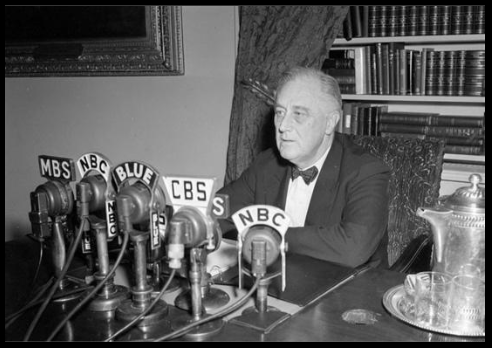
More than 3,500 miles across the Atlantic Ocean, President Franklin Roosevelt had been meeting with his senior military leaders in the White House discussing the unfolding invasion. The night before he had delivered one of his customary radio “Fireside Chats” to the American people, knowing but not sharing information about the massive military mission unfolding in Europe. But this night, June 6 – D-Day – his message would be different.
“Last night when I spoke to you,” he began, “I knew at that moment that troops of the United States and our allies were crossing the Channel…It has come to pass with success thus far…In this poignant hour, I ask you to join me in prayer.” Then, for the first time, a President of the United States led his country in prayer. For our soldiers, he asked God to “lead them straight and true; give strength to their arms, stoutness to their hearts, and steadfastness in their faith.”
For those at home, Roosevelt prayed we would “rededicate ourselves in renewed faith to God in this hour of greater sacrifice” and that with God’s blessing we would “achieve a peace that will let all men live in freedom, reaping the just rewards of their honest toil.”
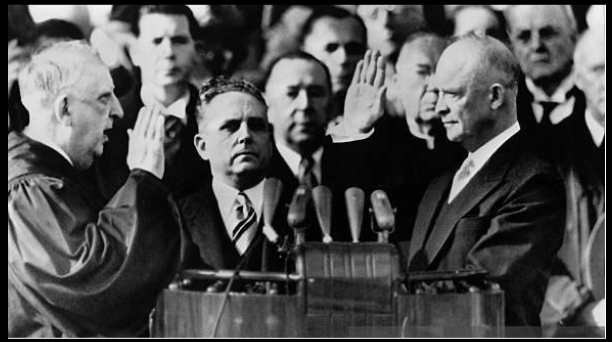
Nine years later, the Supreme Commander of the Allied Expeditionary Force who had led the planning and execution of the events of D-Day stood before the largest inaugural crowd in United States history until that time. Dwight D. Eisenhower had been elected the 34th President of the United States. Having taken the oath required by the Constitution, he approached the podium on the East Portico of the Capitol. “My friends,” he began, “before I begin the expression of those thoughts that I deem appropriate to this moment, would you permit me the privilege of uttering a little private prayer of my own. And I ask that you bow your heads.”
For the second time in our history, a President led his people in prayer, asking that we be given “the power to discern clearly right from wrong…that our concern shall be for all the people, regardless of station, race, or calling…so that all may work for the good of our beloved country and Thy glory.”
From our country’s beginnings, religious devotion and the pursuit of religious freedom have been dominant themes in our history. Massachusetts was founded by Puritans seeking refuge from persecution by the Church of England. Maryland was established by Lord Baltimore as a haven for Catholics while Pennsylvania was established to shelter Quakers and guarantee freedom for other minority sects. Roger Williams advocated freedom of religion and established Rhode Island to assure all faiths, Jews as well as Christians, would be welcome. Even Jamestown, the first permanent British settlement in the New World formed primarily as an economic investment by the Virginia Company of London, included among its goals propagation of the Christian religion to the people they might find in the New World.
Although each of the original thirteen colonies had been established under the authority of a British King and British common law, the mix of religious beliefs and practices throughout the colonies gave impetus to the quest for religious freedom. In his proposal to establish religious freedom in Virginia, Thomas Jefferson noted that “Almighty God hath created the free mind…and the opinions of men are not the object of civil government, nor under its jurisdiction.”
The right of people to think for themselves, to search for truth, and to express themselves freely in the matter of religion – that is, of conscience – laid the foundation for political freedom
Author and historian Jon Meacham summarized it most succinctly in American Gospel. “People who chose their own spiritual path,” he wrote, “wondered why they could not choose their own political path as well.”
Since the founding of Jamestown in 1607, days of prayer and thanksgiving have been proclaimed by hundreds of presidents, governors and legislatures. In 1952 President Harry Truman signed a federal law designating the first Thursday in May as an annual observance. In 2026, that day will be May 7 and observed by Catholics, Protestants, Jews, Hindus, Muslims, Sikhs, and others.
May the thoughts and prayers of these two Presidents – one Democrat, the other a Republican – be ours.