
In June 1731, London’s new Gentleman’s Magazine published a bizarre story detailing an incident that would embroil England and Spain in an extended war seven years later and determine the final border between the North American colony of Georgia and Spanish Florida. It would also have an impact on one of our country’s most sacred historic sites.
The magazine reported that the British brig, the Rebecca, had been stopped and boarded by Spanish naval officers near the coast of Havana in April 1731. Its captain, Robert Jenkins, was accused of engaging in smuggling, bound to a mast, detained, and threatened to have his ship set on fire. His crew was treated severely, but the final indignity was perpetrated on Jenkins when the Spanish captain “took hold of his left ear and with his cutlass slit it down, and then another of the Spaniards took hold of it and tore it off but gave him the piece of his ear again.”
Arriving in Britain on June 11, Jenkins reported the incident to the king and gave his deposition to the Duke of Newcastle who forwarded it to the British commander-in-chief in the West Indies who then complained of Jenkins’ treatment to the Governor of Havana.
Competition for colonization and trade in the Americas had defined relations between Great Britain and Spain for nearly 150 years before Robert Jenkins’ ear was summarily lopped off and apparently safely stored in a bottle as the Rebecca made its way back to England. Both countries had engaged in smuggling, privateering, and diplomatic efforts, including various violated treaties and agreements, to secure their own advantage over the lucrative trade in the Caribbean and protect the vital shipping routes to protect that trade.
Tensions between the two nations increased dramatically in 1733 when the Pacte de Famille between France’s Louis XV and Spain’s Philip V was signed and when the first settlers arrived in the new British colony of Georgia. Britain feared the Pacte could result in France replacing Britain as Spain’s dominant trading partner, while Spain reacted with alarm to the establishment of a new British colony in North America.
Under the leadership of James Oglethorpe, Georgia had been founded to serve as a defensive buffer between Britain’s colony of South Carolina and Spanish-controlled Florida as well as providing a fresh start for England’s poor and imprisoned debtors. Spain viewed this as a direct threat to its vital shipping routes between its American colonies and mainland Spain. Meanwhile, in England internal political divisions challenged the Whig government led by William Walpole, Prime Minister since 1721. Believing Walpole’s policies were out of step with national interests, the Tories favored a war with Spain to secure colonial and commercial gains. This is where Jenkins’ ear comes back on the national scene.
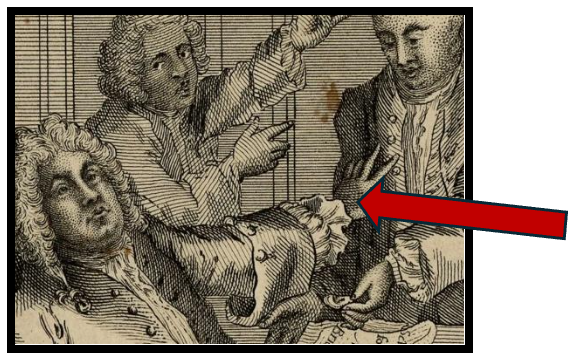
In the spring of 1738, seven years after his unfortunate encounter with the Spanish coast guard, Jenkins was summoned by a committee of the House of Commons where he exhibited what he alleged to be his amputated ear. Contemporary accounts described it as a dried, shriveled piece that had reportedly been kept in a bottle. ( Pickled ear?) The story spread quickly in pamphlets, satirical prints, and cartoons, catching the country’s imagination as Jenkins’ ear became a symbol of English pride and used as a political weapon against Walpole. This humiliation imposed on a British seaman directly contributed to the declaration of war against Spain by King George II on June 15, 1739, and ratified by Parliament on October 23.
The War of Jenkins’ Ear was a limited but important conflict fought between Great Britain and Spain from 1739 to 1748. Most of the fighting took place in the region of the Caribbean Sea, although after 1742 most of the action took place in Europe as part of the War of the Austrian Succession. Nevertheless, Georgia and Spanish Florida engaged in several important battles that resulted in securing Georgia’s independence as a British colony and deployed hundreds of colonists from Virginia and other colonies.
In the summer of 1739, Britain raised a regiment of North Americans to serve in the impending military clashes with Spain. Lawrence Washington, the older half-brother of the future president of the United States, had returned from England the year before, having completed his formal education and prepared to manage his father’s 2,000-acre estate. It was then, for the first time, he met his six-year-old half-brother, George. The next year, Lawrence was awarded a Captain’s Commission in one of Virginia’s companies and deployed to join Britain’s invasion force under the command of Vice Admiral Edward Vernon.
Vernon planned to assault the Spanish fortress at Cartagena (present-day Columbia). The decision involved using some of the Americans as marines. Lawrence was one of them and assigned to Vernon’s three-deck, 80-gun flagship, the HMS Princess Caroline. The assault was a failure, but Lawrence survived to fight in expeditions against New Granada and Cuba before finally returning home to Virginia in January 1746, one of only 17 officers and 130 enlisted men, accompanied by more than 260 sick soldiers of the original contingent of 3,255 men and officers.
The War of Jenkins’ Ear may have succeeded in securing the boundary between Georgia and Spanish Florida, but its meaning to Lawrence Washington was more personal. Upon returning to Virginia and rebuilding a home on the site of his father’s earlier residence, he named it Mount Vernon in honor of his wartime commander.
USA250-OC#57