In mid-October 1824, a sixty-seven-year-old French visitor arrived in Richmond, Virginia. He had been in the United States since August 15, responding to an invitation initiated by President James Monroe and formalized by a joint resolution of Congress which read, in part, that his visit “will be hailed by the People and Government with patriotic pride and joy.”
Called “the Nation’s Guest,” he had already visited Boston, Philadelphia, New York City, and numerous sites throughout the New England States. Everywhere he went, thousands had cheered him. Daily, parades, balls, dinners and commemorations of all kinds were organized to demonstrate their deep affection and revive the ‘spirit of ’76.”
The object of this mass adoration was Marie-Joseph Paul Yves Roch Gilbert du Motier, the Marquis de La Fayette, the last surviving major general of the American War for Independence. Convinced the cause of the thirteen colonies’ rebellion against Great Britain was just, he had made his way to America before his twentieth birthday. Armed with a letter of recommendation from Benjamin Franklin and seven years as a commissioned officer in the French Musketeers, as well as an offer to serve without pay, the Continental Congress appointed him major general on July 31, 1777.
A week later, Lafayette met General George Washington for the first time. Washington had come to Philadelphia to brief Congress on the state of military affairs and was introduced to his newest appointed general. The two men bonded immediately, and the relationship developed as a father for his son – Washington had no children of his own, and Lafayette’s own father had died two years after young Lafayette’s birth.
Within a month, Lafayette fought at the Battle of Brandywine, suffered a wound in his leg, and went on to serve in other battles; departed briefly to France to lobby for increased military support; and returned to fight again for the cause of independence. In 1781, Washington sent Lafayette to Virginia where he and his army harassed British forces led by Benedict Arnold who had earlier betrayed Washington and the Patriots. Lafayette would go on to play a significant role in the battle of Yorktown which effectively ended the war and secured independence for the United States. Among those who participated in the famous surrender at Yorktown on October 19, 1781, were the victorious Continental Army Generals George Washington and the Marquis de Lafayette.
Key to the success of Yorktown was reliable intelligence about the strength and strategy of the British troops under General Charles Cornwallis. An enslaved African American named James had rejected Lord Dunmore’s offer of freedom to slaves who would join British forces and, instead, volunteered for the Continental Army under General Lafayette. With permission of his owner, William Armistead, James posed as a run-away slave and joined Arnold’s camp in Portsmouth, Virginia, presumably willing to act as a spy for the British. Because of his race and condition of servitude, it was easy for James to pass through the lines, pretending to spy on the American Army while passing critical information to the Patriots, including smuggling papers out of Cornwallis’s headquarters confirming that the British general intended to remain in and fortify Yorktown.
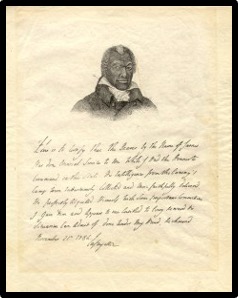
Three years later, on November 21, 1784, while James was attending Armistead as his body servant, he encountered Lafayette who well-remembered him and penned a statement certifying his “essential services” of “intelligence from the enemy’s camp.” He “perfectly acquitted himself,” the testimonial continued, “and appears to me entitled to every reward his situation can admit of.” After submitting two petitions for emancipation for his service during the war, James Armistead was granted his freedom on January 1, 1787, and took Lafayette for his surname.
The passionate love the Marquis de Lafayette had for America and its principles of equality, the rights of all, and self-government were marred only by his distaste for slavery. As early as February 1783 Lafayette was ready to act. Writing from Spain to inform Washington that the treaty of peace between Britain and the United States had been signed, he made a remarkable proposal to collaborate with Washington in a “wild scheme” – to purchase a small estate, emancipate the slaves, and treat them as tenant farmers. Such a project, if successful in America, could be used in the West Indies and begin the long road to the abolition of slavery.
Several years later, Lafayette informed Washington that he had purchased a planation in the colony of Cayenne and was “going to free my Negroes in order to make that experiment which you know is my hobby horse.” Washington sent encouraging and polite replies but did not engage, yet expressed his hope that the spirit of the plan “would diffuse itself generally into the minds of the people of this country, but I despair of seeing it.”
The Marquis spend the rest of his life, including prison and exile, fighting for the rights of man and self-government in his beloved France. James Armistead Lafayette became a fairly wealthy farmer in Virginia and became a slave owner. They were briefly reunited on the Marquis’s triumphant 1824 tour as “the Nation’s Guest” when the Marquis spied James in the crowd as a parade proceeded through Richmond. Calling for the carriage to stop, the two men embraced as the Marquis’s son, George Washington Lafayette looked on.
Broadside of Lafayette’s testimony for James Armistead Lafayette.