
In mid-August 1814, Secretary of State James Monroe, accompanied by a group of twenty-five cavalry men set out to assess whether British troops might attack the nation’s capital, Washington, D.C. France and Britain were already at war when the United States declared war against Britian more than two years earlier, complaining of British encroachments on American commerce and pressing Americans seamen into British service.
British Admiral Alexander Corkraine had issued an order “to destroy and lay waste towns and districts…and spare merely the lives of the unarmed inhabitants of the United States.” Fearing an imminent attack, the residents of the city had begun to evacuate. They were right to prepare. Monroe confirmed their fears, writing to President James Madison, “The enemy are in full march for Washington.” In a postscript, he added, “You had better remove the records.”
Thousands of records dating from the United States’ earliest days were located throughout the Capital – treaties, the unpublished secret journals of Congress, the Articles of Confederation, records of the Confederation and Continental Congress. Among them were the Declaration of Independence, the Constitution, and the joint resolution proposing the Bill of Rights.
During the Revolutionary War, the Declaration had moved with Congress from city to city. When the new government convened in 1789, the Declaration was placed in the custody of the State Department and moved from New York to Philadelphia and finally to Washington, D.C., where its existence was now in jeopardy.
As Dolly Madison, the President’s wife, frantically secured White House documents and directed Paul Jennings, a fifteen-year-old enslaved servant, to save the portrait of George Washington, “if possible,” Stephen Pleasanton was on a mission of his own at the State Department. Hastily crafting make-shift bags out of old course cloth, Pleasanton and several other clerks stuffed them with as many critical documents as they could, including the Declaration and the Constitution.
Loading them into carts, Pleasanton took them to a vacant gristmill a few miles above Georgetown. Realizing that a nearby foundry that made munitions might come under attack, he found another location – the cellar of an abandoned house in Leesburg, about thirty miles from the Capital. For safe keeping, he left the keys with the local sheriff.
British troops stormed into Washington on August 24. Their first target was the south side of the Capital Building where the House of Representatives meets. Setting it on fire, they moved to the north side, ransacking and setting it ablaze before heading up Pennsylvania Avenue to the White House. By the end of the day, most government buildings had been razed or severely damaged, but the Declaration and the Constitution survived.
In 1841, Secretary of State Daniel Webster sent the Declaration to the new Patent Office to be exhibited for public viewing. It remained there for thirty-five years until sent to Philadelphia in 1876 for display at the Centennial National Exposition. Upon its return to Washington, it was housed at the new State-War-Navy building, but its condition had seriously deteriorated from years of exposure and ravages of time.
Until 1921, the Declaration was stored lying flat in the State Department. The next year, recommendations for preservation were made and both the Declaration and Constitution were transferred to the Library of Congress. But two more moves were yet in store for their preservation – one planned, the other of necessity.
On Christmas Eve 1941, less than a month after the attack on Pearl Harbor propelling the United States into World War II, England’s Prime Minister Winston Churchill addressed a joint session of Congress. Later that night, a heavily guarded train pulled out of Union States bound for Fort Knox, Kentucky. Its precious cargo of historical documents, including the Declaration and the Constitution, was being shipped to “a point farther inland on the continent” for its security until the war’s end. But it was accompanied by another, much older document representing the foundations of both American and British liberties – the Magna Carta.
One of only four extant originals of the 1215 Magna Carta, it had been on exhibition at the 1939 New York’s World Fair. When the fair closed in October, the British government extended its stay in the United States to avoid risks of shipping it home in German U-boat infected waters. Left in the custody of the Library of Congress, it was transported to Fort Knox with our Declaration and Constitution until it was safely returned to England in 1944.
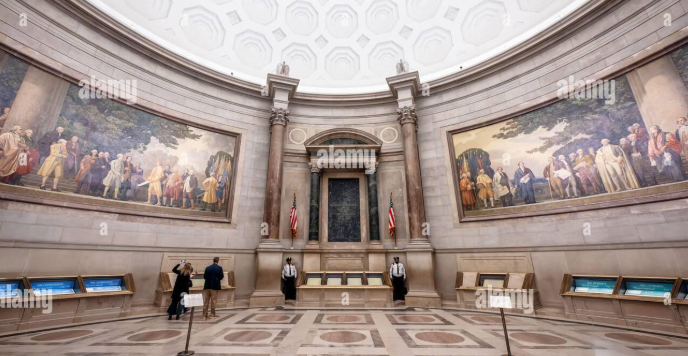
Finally, on December 13, 1952, a grand ceremony took place at the Library of Congress when the Declaration and Constitution were transferred under much pomp and circumstance and heavy military protection to the National Archives where they have been carefully preserved and remain on display.
P.S. On July 2, 1776, Delaware’s Caesar Rodney cast the critical vote for Independence, setting the stage for the Declaration of Independence two days later. His grandnephew, Stephen Pleasanton, would save it from destruction by British soldiers thirty-eight years later.